Sport on Earth › Games › Gym Class Games › Crab Soccer (Crab Football)
Gym Class Games · Scooter games
Crab Soccer (Crab Football)
Soccer played entirely in the crab position: sitting, hands behind you, hips lifted, moving on hands and feet with your belly to the ceiling. Nobody may stand, nobody may touch the ball with their hands, and the goalkeeper is the only player allowed to. It strips out every advantage of height and speed — which is exactly why PE teachers love it.
At a glance
| Players | Two teams of 2–11 depending on space (5–8 a side suits a gym) |
|---|---|
| Equipment | One large, light ball — a cage ball or big foam ball is the classic; a soft soccer ball works |
| Space | A gym or hall with a goal marked at each end; smaller than a soccer field — crab-walking is slow |
| Family | Scooter games |
What it is — and where it comes from
Crab Soccer (Crab Football in Britain) is documented as an informal sport of British origin played commonly in physical education classes, derived from association football with the players crab-walking. Its deeper origin is not documented — reference histories describe it as an informal playground and PE activity of British schools whose structured PE form appears in school activity guides from the later twentieth century, with no single inventor on record.
The game’s standard equipment tells its school story: it is often played with a cage ball — the giant lightweight ball of American PE cupboards — and university health programs (the University of Michigan Health’s children’s activity collection among them) publish it as a children’s fitness game with goals 15–30 feet apart.
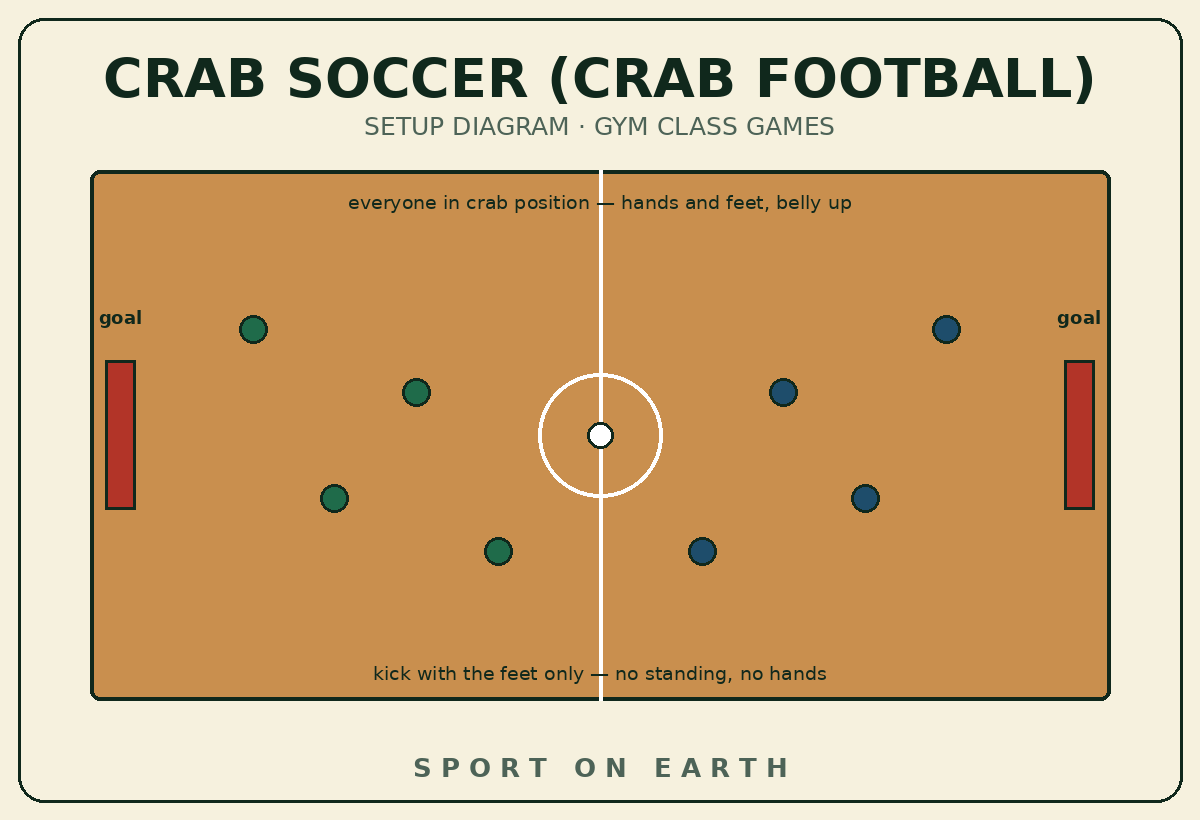
Setup diagram
How to play
Setup
- Mark a goal at each end (cones are fine) on a shortened court. Place the big ball at centre.
- Teams start on their own goal lines, already in crab position: seated, hands flat behind, feet flat, hips raised clear of the floor.
Rules
- Players must stay in crab position whenever the ball is in play: hands and feet on the floor, belly up, hips off the ground. No standing, kneeling up or sitting flat to rest while the ball is live.
- Move the ball with the feet only — dribble it, pass it, shoot it. Handling the ball is a free kick to the other team; the goalkeeper alone may use hands, in front of their own goal.
- A goal is scored by kicking the ball across the opponents’ goal line between the markers (most school forms require the goal to stay below about head height).
- After a goal, restart at centre with the scored-against team in possession. Out of bounds restarts with a kick-in (or a drop-ball, by house rule).
- No kicking at players, no crab-to-crab body contact, and no holding the ball between the feet to stall.
Scoring
One point per goal. First to five wins in the standard informal form, or most goals in the agreed time (short halves — crab position is hard work; 5–8 minutes a half is plenty).
Variations
- Four Mat Crab Soccer: four teams on mats around a centre, numbered players called out to contest the ball while their mat-mates goalkeep (a documented PE lesson form).
- Everyone-goalkeeper: no designated keeper; any player may handle the ball only on their own goal line.
- Balloon crab football for the youngest players: a balloon replaces the ball, and hands may tap it — slower, funnier, safer.
Safety
Crab position loads the wrists and shoulders: short halves, a light ball, and a floor clear of grit. Players whose hips drop to the floor are resting, not fouling — whistle a reset rather than a penalty for young classes.
Video

Sources
- Wikipedia — ’Crab football’ (British origin; PE classes; cage ball; rules)
- University of Michigan Health — ’Crab Soccer’ (children’s activity instructions)
The how-to-play text above is written in this site's own words from these sources. Where a game's origin is not documented, the history section says so plainly — no origin has been invented for any game in this directory.