Sport on Earth › Games › Gym Class Games › Four Square
Gym Class Games · Wall & court games
Four Square
Four squares, one ball, and a line of challengers. The player in the top square serves; everyone else must let the ball bounce once in their square and hit it on into someone else’s. Fault, and you go to the back of the line while everyone shuffles up — the whole game is the climb toward the serving square.
This game is also one of the 435 census sports: see the Four Square sport page for its full record — news, history, guides and data.
At a glance
| Players | 4 on court plus a waiting line — any number can rotate through |
|---|---|
| Equipment | One rubber playground ball (8.5-inch is the standard size) |
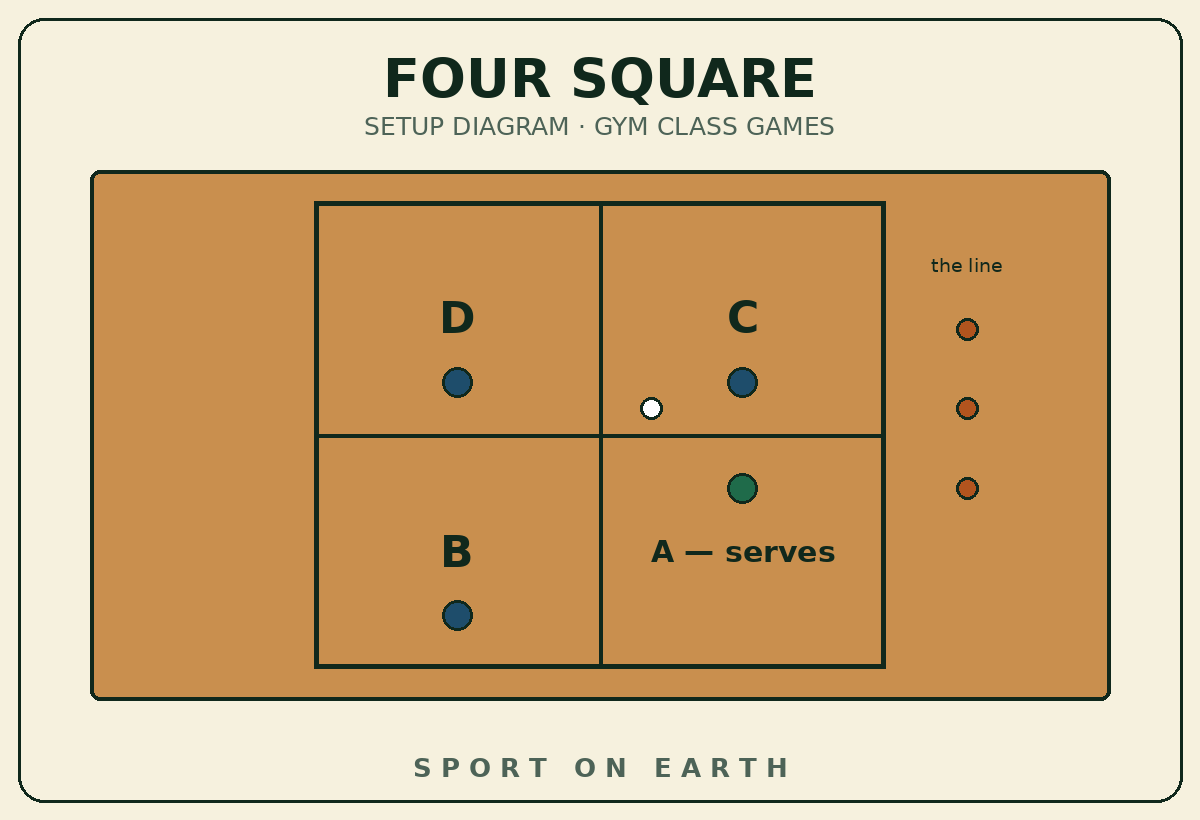
| Space | A square court about 16 feet across, divided into four equal squares lettered A–D (or numbered 1–4) |
| Family | Wall & court games |
What it is — and where it comes from
Four Square is documented in print from the 1950s: the game is mentioned in newspapers in the northeastern United States at least that far back, and a 1953 Cincinnati Public Schools teacher’s manual, the Primary Manual, describes it with the same rules used today — a large rubber ball and a court marked into four squares lettered A, B, C and D.
Beyond that, the origin is not documented, and claims that it descends from older European handball games are speculation, printed as such where they appear. What is documented is its modern life as a schoolyard standard — including, since 2005, an annual World Four Square Championship hosted in Bridgton, Maine. The site’s own census carries Four Square / FS Handball as a sport; this page is its gym-class form.
Setup diagram
How to play
Setup
- Mark a square court (16 feet across is the standard; smaller for younger players) and divide it into four equal squares, lettered A (highest) through D, or numbered 4 down to 1.
- One player stands in each square; the rest line up outside, in order, at the lowest square.
Rules
- The player in the top square (A / square 4) serves: bounce the ball once in their own square, then hit it underhand into another player’s square.
- The receiving player lets the ball bounce once in their square, then hits it — underhand, with the hands — into any other square. Play continues in the same way.
- A player is out for: failing to hit the ball after it bounces in their square, letting it bounce twice, hitting it out of the court or into their own square, holding or catching the ball, or hitting it overhand (house rules vary).
- The player who is out leaves the court and goes to the back of the line; everyone below them advances one square, and the first player in line enters the lowest square.
- The server’s square makes the house rules: at the start of each reign the A player may call special rules (no slams, ’around the world’ serving order, double taps allowed) that bind until they are dethroned.
Scoring
There is no points score in the standard game: success is reaching and holding the top square. Timed games can count serves survived or rounds as A.
Variations
- Two Square: the same game on two squares — the form the 1953-style manuals treat as four square’s sibling.
- King’s Court calls: ’cherry bomb’ (a hard downward slam), ’double touch’ (juggle once in your own square, then hit on), ’around the world’ (the serve must visit every square in order).
- Elimination line: instead of rotating to the back of the line, an out player is eliminated for the game; last four play a final.
Safety
Underhand hits only in the school game; slams (’cherry bombs’) are a house rule for older players, and the waiting line stands clear of the court corners.
Video

Sources
- Wikipedia — ’Four square’ (1950s record, 1953 Cincinnati Primary Manual, rules, Bridgton championships)
- Sports Feel Good Stories — Four Square: history, rules and game play
The how-to-play text above is written in this site's own words from these sources. Where a game's origin is not documented, the history section says so plainly — no origin has been invented for any game in this directory.