Sport on Earth › Games › Gym Class Games › Mat Ball (Matball)
Gym Class Games · Diamond games
Mat Ball (Matball)
Kickball moved indoors and turned up: the bases are gym mats big enough to hold a crowd, there are no force-outs, runners may set off whenever they like, and a run only counts when a runner has gone round the diamond twice. Mat Ball is the rainy-day diamond game of American PE — documented as a deliberate variation built to keep big classes moving.
At a glance
| Players | Two teams — a whole class split in half works best (10–30) |
|---|---|
| Equipment | Four gym mats (one per base), one indoor soccer ball or playground ball, flags or rags for the second lap |
| Space | A gym floor with the four mats laid out as a baseball diamond |
| Family | Diamond games |
What it is — and where it comes from
Mat Ball’s documented history starts as a variation, and says so: Physical Education Update’s ’Games: Matball Variations’ (by Dennis Docheff and Darrin Smith of Concordia University, Wisconsin) introduces it as a variation of kickball that produces interest from middle and high school students, and as a good rainy-day activity when classes are forced to share the gym. No earlier origin is documented, and none is claimed here.
The design choices in that published version are the game’s identity: two runners leave home together on every kick, more than one runner may share a mat, runners must circle the diamond twice — picking up a flag at home on the first pass to prove the second lap — and there are no force-outs at any base.
Setup diagram
How to play
Setup
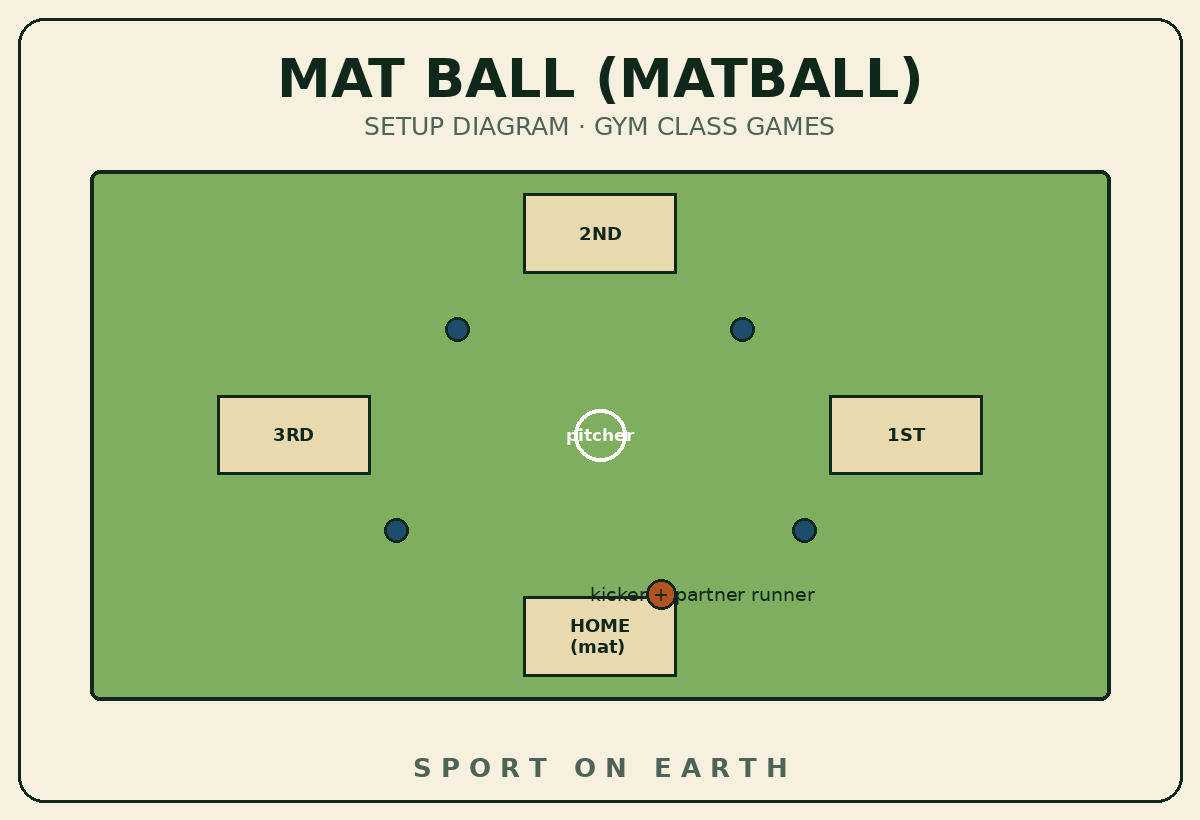
- Lay the four mats on the gym floor in a diamond, one for home and one for each base, at kickball spacing.
- Split the class into two teams; one fields, the other kicks. Set a pile of flags (or rags) beside the home mat.
- The fielding team spreads out as in kickball; the pitcher stands at the centre.
Rules
- The pitcher rolls the ball over the home mat; a pitch that does not pass over the mat is not a good pitch.
- The kicker kicks the ball anywhere in the field — bunting is allowed — and TWO runners set off together: the kicker and a teammate. Both run the bases.
- Runners must stay on the baseline path; leaving it is an out. More than one runner may be on a mat at the same time.
- Once on a mat, a runner may set off again at any time — there is no rule that you must wait for the next kick.
- There are no force-outs. A runner is out only if a fielder tags them with the ball or throws the ball and hits them (on the fly or on a bounce) while they are off a mat.
- Three outs end the half-inning; teams swap, and play innings as in kickball.
Scoring
A runner scores by rounding the diamond TWICE: crossing home the first time, they pick up a flag; reaching home again still carrying the flag scores one run.
The team with more runs after the agreed number of innings wins.
Variations
- One-lap Mat Ball for younger classes: a single circuit scores, no flags.
- Everyone-kicks innings: instead of three outs, every player on the kicking team kicks once per inning.
- Outdoor version: PE Update notes the game works outside too — use bases or cones in place of mats.
Safety
Fielders throw at runners’ bodies below the shoulders only; with two runners live at once, call ’hold’ throws near the mats to avoid collisions.
Video

Sources
The how-to-play text above is written in this site's own words from these sources. Where a game's origin is not documented, the history section says so plainly — no origin has been invented for any game in this directory.