Sport on Earth › Games › Gym Class Games › Pinball (the PE game)
Gym Class Games · Target games
Pinball (the PE game)
Not the arcade machine: PE Pinball is a passing game with a target. Move the ball up the court by throwing and catching — four different teammates must complete a catch before anyone may shoot — and score by knocking over the other team’s bowling pin, which stands in a hula hoop that nobody may step inside.
At a glance
| Players | Two teams of 5–12 (a full class in two teams) |
|---|---|
| Equipment | One foam dodgeball, two bowling pins, two hula hoops, pinnies |
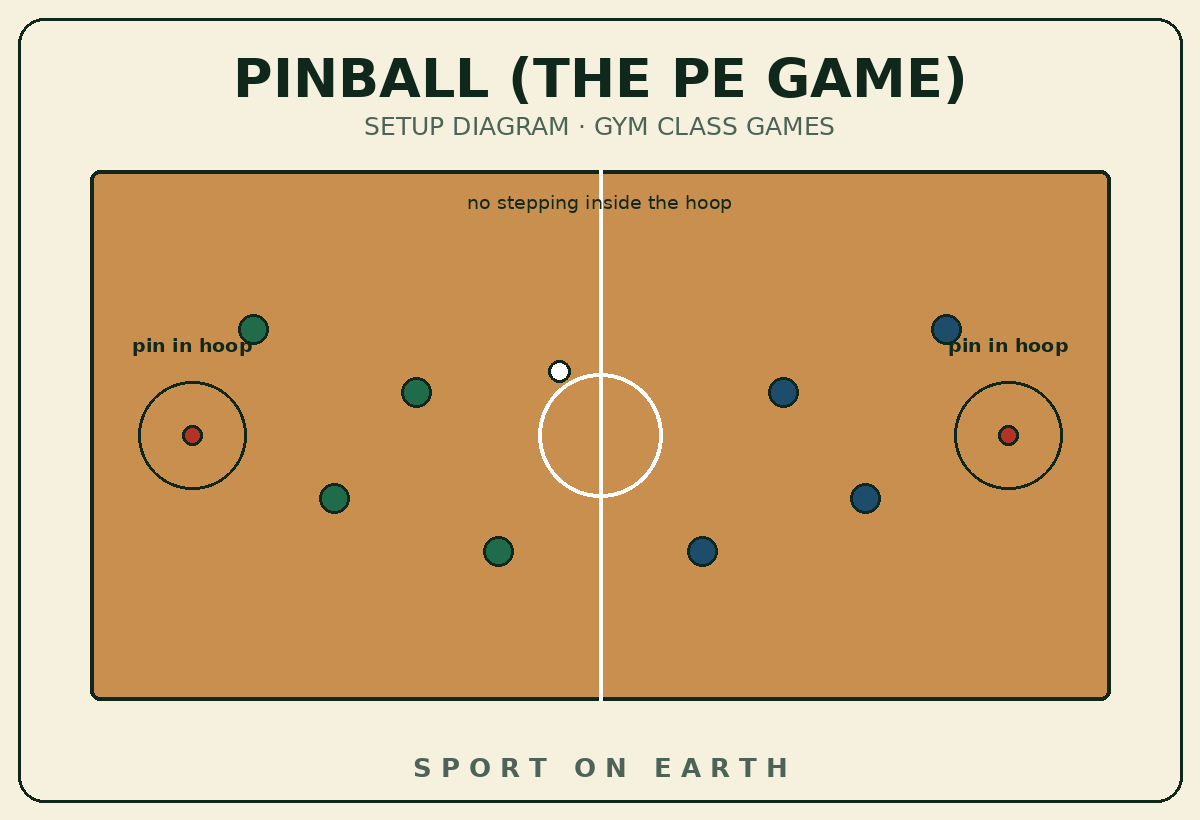
| Space | A basketball court — the pins sit in hoops at the centre of each free-throw lane |
| Family | Target games |
What it is — and where it comes from
Pinball’s origin is not documented as a published game with an inventor; what is documented is its life as a teacher-shared PE lesson game. The fullest written version is a PE lesson plan by Joshua Short (grades 3–12), who notes on the plan itself that he got the game from a classmate in a Techniques for Teaching Physical Education class — which is exactly how gym-class games usually spread: teacher to teacher, gym to gym.
Short’s plan describes Pinball as a modified version of Ultimate Football played with a dodgeball instead of a football: the same no-running-with-the-ball passing game, except that scoring means knocking over the other team’s bowling pin with a thrown ball. The four-catch rule before a shot, the no-stepping-in-the-hoop rule and the own-pin rule below all come from that documented plan.
Setup diagram
How to play
Setup
- Place one hula hoop at the centre of the free-throw lane at each end of the basketball court, with one bowling pin standing inside each hoop.
- Two teams in pinnies; the court boundary lines are the playing boundaries.
- One team starts with the foam ball at its own end.
Rules
- Players move the ball by throwing and catching. A player who catches the ball may take one step only to keep balance — no travelling up the court with the ball.
- A team must complete catches by FOUR different teammates on a possession before it may shoot at the pin.
- To score, throw the ball and knock over the opposing team’s pin. A player may not knock the pin over while holding the ball, and no player may step inside the hula hoop — attackers or defenders.
- If a team knocks down its OWN pin while guarding it, the point goes to the attacking team.
- No contact: if contact is made, the team on offence keeps the ball at the spot of the contact.
- The offence may run with the ball only once it has advanced inside the three-point line at the attacking end (per the source plan); everywhere else it is a passing game.
- After a score, the pin is stood back up and the other team restarts with the ball.
Scoring
One point per pin knocked down. Play to an agreed total or for a set time; most pins down wins.
Variations
- Three-second rule: a player may hold the ball for at most three seconds, to speed the game up (suggested in the source plan).
- Two pins per end for large classes, one in each corner of the lane.
- Rolling shots only: shots at the pin must be bowled along the floor.
Safety
Foam ball only, throws at the pin — never at players — and the hoop is a strict no-step zone so nobody dives onto the pin.
Video

Sources
The how-to-play text above is written in this site's own words from these sources. Where a game's origin is not documented, the history section says so plainly — no origin has been invented for any game in this directory.