Sport on Earth › Games › Gym Class Games › Red Light, Green Light
Gym Class Games · Tag & chase games
Red Light, Green Light
The caller stands with their back turned and calls ’Green light!’ — everyone runs. ’Red light!’ — the caller spins round and everyone must be a statue; anyone caught moving goes back to the start. First to tag the caller takes the job. It is the North American form of one of the world’s most widespread children’s games.
At a glance
| Players | 4 or more — one caller against the field |
|---|---|
| Equipment | None |
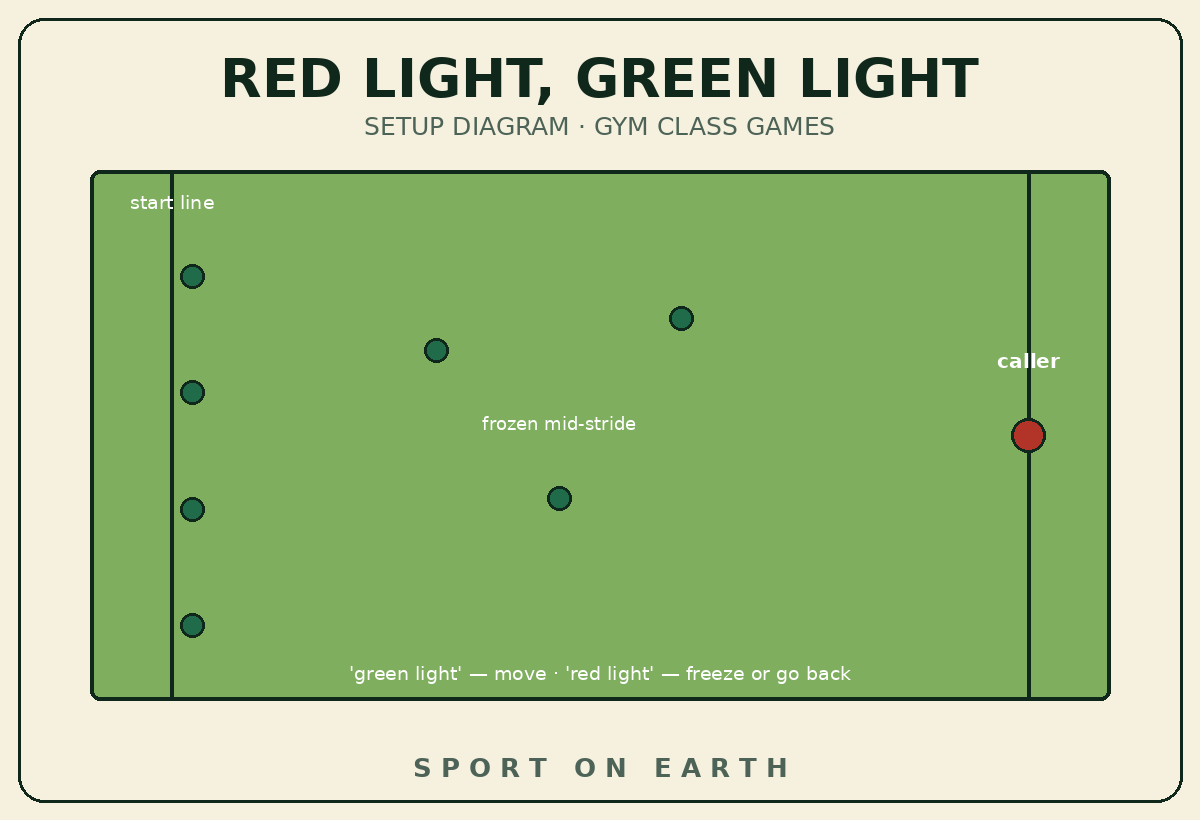
| Space | A long, clear run — a gym length or a field — with a start line and the caller at the far end |
| Family | Tag & chase games |
What it is — and where it comes from
Red Light, Green Light is the North American form of the game known internationally as Statues — ’Grandmother’s Footsteps’ or ’Fairy Footsteps’ in the United Kingdom — in which a ’curator’ turns their back while the statues creep up, and spins round to catch them moving. The traffic-light name is the American variation on that older form, and the reference record treats the two as one game family.
The same game is played under a different chant in South Korea — ’Mugunghwa kkochi pieotseumnida’ (’the hibiscus flower has bloomed’), named for the national flower — where it remains a standard schoolyard game; its global familiarity in that form is documented in accounts of Korean children’s games. No single inventor is documented for any version.
Setup diagram
How to play
Setup
- Mark a start line. The caller stands at the far end, back turned to the players, who line up behind the start line.
- Agree the penalty for moving: back to the start line (standard) or out for the round (strict form).
Rules
- The caller, facing away, calls ’Green light!’ — players run toward the caller.
- At any moment the caller calls ’Red light!’ and turns around. Every player must freeze instantly and hold the freeze while the caller looks.
- Any player the caller sees moving — a step, a wobble corrected, an arm swing — is sent back to the start line.
- The caller turns back and calls ’Green light!’ again. The caller controls the rhythm: fast calls catch runners mid-stride; slow calls let them cover ground.
- The first player to reach and tag the caller without being sent back wins the round.
Scoring
The winner becomes the caller for the next round. In class form, count how many players reach the caller in a set number of rounds — the field against the caller.
Variations
- Statues / Grandmother’s Footsteps: no calls — the curator turns at will, may walk among the statues inspecting them, and caught movers return to the start.
- Korean form: the caller chants ’Mugunghwa kkochi pieotseumnida’ with their back turned; players move only during the chant and freeze when it ends and the caller turns.
- Team form: if ANY player is caught moving, the whole field returns to the start — the caller’s dream, the field’s nightmare.
Safety
Freezing at a run is a falling hazard for the youngest players: keep the run-up on grass or a gym floor, shorten the distance, and let small children freeze ’like a statue’ rather than policing tiny movements.
Video

Sources
- Wikipedia — ’Statues (game)’ (Red Light, Green Light as the North American variation; general rules)
- VOX ATL — ’The Real-Life History and Traditions Behind Those Squid Game Games’ (Korean mugunghwa form)
The how-to-play text above is written in this site's own words from these sources. Where a game's origin is not documented, the history section says so plainly — no origin has been invented for any game in this directory.