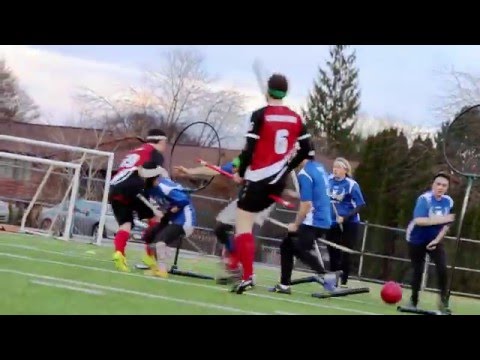
SFU Quidditch Highlight Reel @ QC WRC2016
YouTube · Danny Ly
Pages
On this page
Sport on Earth › Sports
Sport on Earth · Sport
Broomstick sport from Harry Potter that inspired Quadball.
Every embed below was verified playable before listing — the network’s standing rule.
YouTube · Danny Ly
YouTube · HippoPlaysHalo
Pages
On this page
No game on this site is made specifically for Quidditch yet. The games below are the site's all-sport games, which honestly cover every sport — nothing from another sport has been dressed up as this sport's game.
A new set of questions every day, across every sport this site covers.
Real-athlete Top Sport on Earth decks built from the site’s verified board data.
Quidditch's lab is the Physics Lab section on this page — the applied physics of its sport family, with a computed interactive where one honestly fits.
Physics Arena — the general biomechanics & physics teaching sandbox, shared by every sport.
The homepage sport explorer also carries a general Lab tab of small interactive experiments.
Calendar data not yet carried for Quidditch — this site does not yet hold schedule data for it, so no dates are shown rather than invented.
Which section of this page should we expand first?
Votes are counted on the Sport on Earth server and the totals shown are every reader’s votes; your own choice is remembered in this browser.
Sport on Earth does not yet hold verified dated events for Quidditch, and its carried record does not state the season's timing in words — so no calendar is shown rather than an invented one. What the site does carry for this sport is on this page: its verified record, its rules record and its history.
This sport is fictional or speculative: it has no verified real-world playing record, equipment or measurements for this site to compute with. Sport on Earth does not invent physics parameters for invented sports, so this lab carries an explanation instead of a calculator.
Where the fiction borrows from real sports, the real family’s lab applies: projectile flight, spin and impact work exactly as the Physics Arena on the Games page demonstrates with printed formulas.
From this sport's own record: Broomstick sport from Harry Potter that inspired Quadball. The lab above treats the physics of the sport's family; no measurement specific to this sport is printed, because the site's verified record for it carries none — parameters are never invented to fill a lab.
No calculator is offered for this sport — honestly, none fits without inventing parameters. The site's general Physics Arena remains the hands-on sandbox, with every formula printed.
The general teaching sandbox for every sport is the Physics Arena on the Games page — the same printed models, with a defender added.
The hands-on lab for Quidditch, built entirely from the record this site carries for it — its documented rolls, its halls, its venues, its calendar and its census family. Every figure below is computed from that carried record at build time; nothing is estimated and nothing is pulled live. The companion Physics Lab on this page works the family's physics; this lab works the record.
The honest position: the record this site carries for Quidditch is thin — no documented roll, hall, venue set or dated calendar is carried for it yet — so this entry’s lab is its family lab: the computed census of the family it belongs to. When the record grows, the lab grows with it; nothing here is estimated to fill the space.
Computed from the site census: the Fictional sports family holds 7 entries on this site. Across the family, the carried record includes documented rolls for 0 of them, Hall of Fame data for 0, venue sets for 0, and dated calendars for 0.
Every other entry in the family: Baseketball · Blitzball (Final Fantasy X) · Light Cycle Racing · Motorball · Podracing · Zero-G Athletics
Basis: the Sport on Earth census itself — the same 460-entry register the census page prints.
The desk has not verified a sponsorship record for Quidditch from published sources, so none is printed. Sponsorship history is added only when a real published source supports it — sponsor by sponsor, deal by deal. Current sponsorship deals across sport are tracked on the Money Desk sponsorship page.
How this game is played, gathered from the record Sport on Earth already carries for Quidditch, with the positions taken from the sourced chart cited in that section.
Sport on Earth carries no separate rules list for Quidditch; the governing framework its record carries is this:
Quidditch is carried on this site as the heritage name of the real sport now called Quadball — renamed by US Quadball and the IQA in 2022 to separate the real sport from the Harry Potter franchise (and the author’s public positions), with Major League Quidditch becoming Major League Quadball. The full rule-change dossier, including the renaming itself, lives on the Quadball page; this heritage page carries no duplicate entries by design.
Positions for Quidditch are not yet sourced on Sport on Earth: no verified positions chart has been carried for this sport yet, so none is shown here rather than an invented one. That says nothing about whether the sport has positions — only that they have not been sourced for this page yet.
Its Playbook — its opening entries, the basic plays, are:
The full book carries 7 entries — in this page’s Playbook / Tactics & Strategy section, and at the Playbooks hub.
Quidditch is an invented sport: it has no real equipment, and so no equipment history exists to carry. Sport on Earth prints that plainly rather than fabricate a timeline for equipment that was never made.
Sport on Earth's own analytics: every figure in this panel is computed at build time from the record this site itself carries, with the source named. No outside data is used, and no betting figures of any kind.
Census arithmetic: Quidditch sits in the invented sports family — 7 census sports, of which 0 carry a qualifying champions roll in the site's record.
The carried record for Quidditch is too thin for computed panels: no champions roll, hall-of-fame list or venue record is carried for it. This panel therefore prints the census arithmetic only — the honest answer rather than a manufactured figure.
How the laws of Quidditch are governed today — the documented record, stated plainly.
Quidditch is carried on this site as the heritage name of the real sport now called Quadball — renamed by US Quadball and the IQA in 2022 to separate the real sport from the Harry Potter franchise (and the author’s public positions), with Major League Quidditch becoming Major League Quadball. The full rule-change dossier, including the renaming itself, lives on the Quadball page; this heritage page carries no duplicate entries by design.
That framework summary is the whole documented record Sport on Earth can verify for this sport — no major dated rule changes are carried, rather than invent any.
Source basis: The governing body’s published framework as summarised in this section (see the framework text).
Sport on Earth carries no results feed for Quidditch: no scores or fixtures are published here, rather than inventing them. The sport's documented record is in its history page and the History & Records section of this page.
The historical record for Quidditch — past standings, champions, title history and all-time leaders, as deep as verifiable public records go.
Season-by-season standings, historical player statistics and title rolls are not carried for Quidditch: no public archive publishes them in a form Sport on Earth can verify, and this site does not invent history. What is carried for this sport is its verified record, its rule-change history and its league history — elsewhere on this page.
The review and analysis videos from Quidditch’s verified video pool — every embed below was identity-checked and probed playable before listing, the site’s standing rule. Nothing here is a show Sport on Earth produces; these are the review, post-game and breakdown videos the pool already carries for this sport.
No verified review-show video is carried for this sport yet.
The filter sorts the Review Room embeds and the picture cards above by the keywords in their carried titles (review / analysis / recap and similar, or highlights). It runs entirely in your browser — nothing is sent anywhere.
This sport is a work of fiction, so no real hall of fame exists for it — and Sport on Earth does not invent one. If a recognised hall ever publishes an inductee list for it, it will be carried here from that list.
Broomstick sport from Harry Potter that inspired Quadball.
In the wider fiction family of sports — no lab — and why that is the honest answer, the game turns on: The source work is the rulebook: a fictional sport’s laws exist only as its creator wrote and showed them, so its own canon — not any real sport’s laws — is the authority.; Depiction is edited: screen and page versions skip the slow passages, so a highlight is evidence of the spectacle, not of the whole game’s shape.; Adaptations change the physics: when a fictional sport is played for real — as broomstick Quidditch became Quadball — the impossible parts are redesigned, and the adaptation’s rules are its own.; Internal consistency is the standard: a fictional sport is judged by whether its stated rules cohere and produce the contests its stories show..
Sport on Earth carries no team or player directory for this sport, because no structured public feed publishes a verifiable one. What is carried is the documented record on this page — history, rules, honours and the calendar — each with its source named.
The Quidditch record book is still thin: beyond the standings, rules and calendar layers on this page, no verified winners roll or honours list is carried yet. The desk adds record material only when a published source can be named for it — never from memory or invention.
More from the desk: the expert guide to Quidditch · the site-wide Writing Desk · every sport on Earth.
📖 The Quidditch Playbook — every entry, plus the arcade strategy, at the foot of this page.
An arcade take on Quidditch: set the angle, set the power, and land the quaffle in the hoops. Five attempts; the closer to the middle, the more it scores. Arcade distances and a training arc — a game in the spirit of the sport, not a simulation of it.
This page’s own game is the arcade above. Everything else on the site that fits this sport is listed here — and anything borrowed from a similar sport is labelled as that sport’s game, never passed off as this one’s.
The tools on this site that honestly run on Quidditch — its own record first, then the site-wide general tools that apply. The full Quidditch toolkit prints the ones that do not apply, with the data reason why.
No bench tool yet computes from Quidditch’s own carried record — the general tools below are the ones that honestly apply.
Site-wide tools, not built for Quidditch alone: Tournament Planner · My Notebook · The Labs · Design Studio · The Makers’ Bench · Custom Rulebook Generator.
The Playbook — a fictional sport’s own canon, labelled as fiction
the fictional game’s canon tactics, labelled as fiction: Quidditch as written in its source novels — the plays below are the ones the books themselves name and describe.
7 entries, plus the arcade strategy below. All wording is original coaching-vocabulary prose; nothing is copied from any proprietary playbook.
Three chasers fly in an arrowhead, intimidating the defence and forcing it wide — the formation the novels name as the classic chaser pattern, designed to open the scoring area for the trailing chaser.
When it’s used: Canon: named in the source fiction as the standard attacking shape.
The sequence
The seeker dives at the ground as if he has seen the Snitch at his feet, hoping the opposing seeker follows and crashes or pulls out too late — the novels’ most famous piece of gamesmanship, named for Josef Wronski.
When it’s used: Canon: the feint is legal, dangerous, and a seeker’s reputation made in one dive.
The sequence
Bludgers are hit backward over the shoulder (the backbeat) to wrong-foot chasers, and beaten in pairs (the Dopplebeater) when both beaters strike the same bludger together for double power — the novels’ named beater crafts.
When it’s used: Canon: beater technique as the source fiction teaches it.
The sequence
The pincer flies two chasers at the opposing carrier from both sides to force the pass; the Woollongong Shimmy shakes a chaser’s broom in a high-speed zigzag to unseat the defence’s aim — both named in the canon’s own coaching literature.
When it’s used: Canon: from the fiction’s internal coaching book, ’Quidditch Through the Ages’ as the novels present it.
The sequence
The Snitch is worth 150 points and ends the game, so the canon’s endgame is arithmetic: a team more than 150 behind must stall the enemy seeker, and a team within reach may catch to lose narrowly on purpose in league standings — the novels play both calculations openly.
When it’s used: The fiction’s own coaches do the standings maths on the page; the play is the calculation.
The sequence
In the fiction’s league structure, a season’s standings can make a narrow loss worth more than a reckless win — the canon’s captains play the table as openly as the match, which the novels treat as professionalism, not cynicism.
When it’s used: Canon league craft
The sequence
The keeper guards three separate hoops rather than one goal: his positioning is a choice of which hoop to concede least, and the chasers’ defence funnels shots to the hoop he has chosen to defend personally.
When it’s used: Canon defence
The sequence
The arcade cell · strategy
This page’s arcade cell: launch the quaffle at the hoops from toward the ring · 34 m (arcade scale). Angle, power, launch — five attempts, and the cell keeps your best.
When it’s used: On this page, in the Play section — and its strategy is the same craft as the book above it, miniaturised.
The sequence
Part of the Sport on Earth Playbooks — a book for every sport and every game on the site.
Behind the Play · From the carried record
Broomstick sport from Harry Potter that inspired Quadball.
Behind the Play takes the decisive actions of Quidditch apart: how the scoring play is built, which patterns the players are really running, and which rules remade the play into its modern shape.
Source basis: this sport’s carried record on this page (verified record, rule-changes dossier, history datasets) and the play patterns of its family as written in the site’s guides. Nothing here is invented.