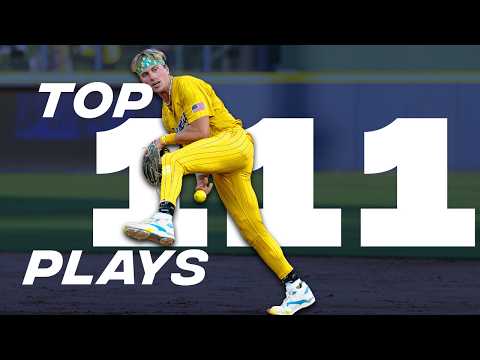
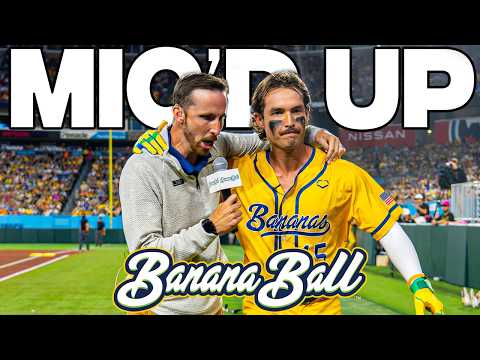
The TOP 100+ Banana Ball Plays from 2024
YouTube · Banana Ball
Pages
On this page
Sport on Earth › Sports
Sport on Earth · Sport
Baseball rewritten for pace and show — win the inning, beat the two-hour clock, in the Savannah Bananas’ Banana Ball Championship League.
Sport on Earth’s daily and weekly video shows for Banana Ball — every episode, newest first.
The first episode is in production and lands here the morning it is produced — no episode is listed until it exists.
Every embed below was verified playable before listing — the network’s standing rule.
YouTube · Banana Ball
YouTube · Banana Ball
Pages
On this page
No game on this site is made specifically for Banana Ball yet. The games below are the site's all-sport games, which honestly cover every sport — nothing from another sport has been dressed up as this sport's game.
A new set of questions every day, across every sport this site covers.
Real-athlete Top Sport on Earth decks built from the site’s verified board data.
Banana Ball's lab is the Physics Lab section on this page — the applied physics of its sport family, with a computed interactive where one honestly fits.
Physics Arena — the general biomechanics & physics teaching sandbox, shared by every sport.
The homepage sport explorer also carries a general Lab tab of small interactive experiments.
Calendar data not yet carried for Banana Ball — this site does not yet hold schedule data for it, so no dates are shown rather than invented.
Which section of this page should we expand first?
Votes are counted on the Sport on Earth server and the totals shown are every reader’s votes; your own choice is remembered in this browser.
Sport on Earth does not yet hold verified dated events for Banana Ball, and its carried record does not state the season's timing in words — so no calendar is shown rather than an invented one. What the site does carry for this sport is on this page: its verified record, its rules record and its history.
A delivery in bat-and-ball sports is a projectile with a twist: it may bounce (cricket-family) or fly flat (baseball-family), and in both families it can curve — swing and seam in cricket, breaking balls in baseball — because a spinning or asymmetrically rough ball deflects in moving air (the Magnus effect and boundary-layer behaviour). The calculator below runs the core flight model with its assumptions printed: no air resistance, no spin, flat ground.
The batter’s problem is time: elite deliveries allow roughly four-tenths of a second from release to arrival, less than a full decision-and-swing cycle — which is why batters predict from the deliverer’s action rather than reacting to the ball. Pitch/shot speed, release height and bounce all trade against that reaction window.
From this sport's own record: Baseball rewritten for pace and show — win the inning, beat the two-hour clock, in the Savannah Bananas’ Banana Ball Championship League. The lab above treats the physics of the sport's family; no measurement specific to this sport is printed, because the site's verified record for it carries none — parameters are never invented to fill a lab.
Model: R = v²·sin(2θ)/g, flight time T = 2·v·sin(θ)/g, apex H = (v·sin θ)²/(2g), g = 9.81 m/s². Assumptions: no air resistance, no spin, flat ground, launch and landing at the same height. Real balls and shuttles fly shorter and curve — drag and spin are exactly what this model leaves out, so treat the output as the gravity-only ceiling, not a prediction.
The general teaching sandbox for every sport is the Physics Arena on the Games page — the same printed models, with a defender added.
The hands-on lab for Banana Ball, built entirely from the record this site carries for it — its documented rolls, its halls, its venues, its calendar and its census family. Every figure below is computed from that carried record at build time; nothing is estimated and nothing is pulled live. The companion Physics Lab on this page works the family's physics; this lab works the record.
The honest position: the record this site carries for Banana Ball is thin — no documented roll, hall, venue set or dated calendar is carried for it yet — so this entry’s lab is its family lab: the computed census of the family it belongs to. When the record grows, the lab grows with it; nothing here is estimated to fill the space.
Computed from the site census: the Bat-and-ball games family holds 29 entries on this site. Across the family, the carried record includes documented rolls for 2 of them, Hall of Fame data for 3, venue sets for 4, and dated calendars for 3.
Every other entry in the family: Balle Pelote · Baseball · Baseball5 · Bat and Trap · Blitzball · Corkball · Cricket · Gilli-Danda · Hornussen · Kickball · Kilikiti · Lapta · Longue Paume · Oină · Over-the-Line · Palant · Pallone Elastico · Pelota Mixteca · Pelota Valenciana · Pesäpallo · Ritinis · Rounders · Schlagball · Softball · Stoolball · The Hundred · Vigoro · Wiffle Ball
Basis: the Sport on Earth census itself — the same 460-entry register the census page prints.
The desk has not verified a sponsorship record for Banana Ball from published sources, so none is printed. Sponsorship history is added only when a real published source supports it — sponsor by sponsor, deal by deal. Current sponsorship deals across sport are tracked on the Money Desk sponsorship page.
How this game is played, gathered from the record Sport on Earth already carries for Banana Ball, with the positions taken from the sourced chart cited in that section.
Banana Ball is baseball rebuilt for pace and showmanship by Jesse Cole and Fans First Entertainment in Savannah, Georgia. The Savannah Bananas were founded in 2016 as a college summer team in the Coastal Plain League, then left traditional league play in 2022 to play Banana Ball full-time — and the exhibition format outgrew the team: in 2026 it became a league of its own, the Banana Ball Championship League, with six teams touring the United States (the 2026 tour was billed at 75 stadiums in 45 states).
The 11 rules that make it Banana Ball — the rules as this site's record carries them:
Positions for Banana Ball are not yet sourced on Sport on Earth: no verified positions chart has been carried for this sport yet, so none is shown here rather than an invented one. That says nothing about whether the sport has positions — only that they have not been sourced for this page yet.
Its Playbook — its opening entries, the basic plays, are:
The full book carries 10 entries — in this page’s Playbook / Tactics & Strategy section, and at the Playbooks hub.
Sport on Earth's own analytics: every figure in this panel is computed at build time from the record this site itself carries, with the source named. No outside data is used, and no betting figures of any kind.
Census arithmetic: Banana Ball sits in the bat-and-ball sports family — 29 census sports, of which 3 carry a qualifying champions roll in the site's record.
The carried record for Banana Ball is too thin for computed panels: no champions roll, hall-of-fame list or venue record is carried for it. This panel therefore prints the census arithmetic only — the honest answer rather than a manufactured figure.
Banana Ball is baseball rebuilt for pace and showmanship by Jesse Cole and Fans First Entertainment in Savannah, Georgia. The Savannah Bananas were founded in 2016 as a college summer team in the Coastal Plain League, then left traditional league play in 2022 to play Banana Ball full-time — and the exhibition format outgrew the team: in 2026 it became a league of its own, the Banana Ball Championship League, with six teams touring the United States (the 2026 tour was billed at 75 stadiums in 45 states).
Launched its inaugural six-team season in 2026, after being announced in 2024.
All six teams play the same 11-rule Banana Ball rulebook and tour rather than sitting in fixed home stands — the Bananas’ home base is historic Grayson Stadium in Savannah.
The Savannah Bananas are the founding team; the Party Animals are their original rivals, the Firefighters were announced as the third team, the Texas Tailgaters joined in 2025, and the Indianapolis Clowns and Loco Beach Coconuts joined for the league’s first season in 2026.
Banana Ball publishes no structured data feed this site can mirror, so Sport on Earth carries no fixtures, results or player statistics for it — the league and team facts above are the verified record as of November 2026, and this page will say so rather than invent a schedule.
Sources, verified November 1, 2026: ESPN — What is ’Banana Ball’? Rules, Savannah Bananas history, more · Savannah Now — The rules of Banana Ball · SeatGeek — Banana Ball explained: the other teams
Banana Ball is baseball deliberately re-engineered as entertainment — the Savannah Bananas’ rules are the product, and they read as a point-by-point indictment of baseball’s dead time.
Before: Traditional baseball: nine innings, three-hour games, bunting, mound visits, foul balls into the stands as souvenirs, walks as a slow walk, and innings of unlimited scoring that could bury a team by the third.
The change: Banana Ball’s code, point by point against tradition: (1) win innings, not total runs — most innings won takes the game, so every inning is a fresh contest; (2) a two-hour time limit; (3) no stepping out of the batter’s box; (4) no bunting (ejection); (5) batters may steal first base on a wild pitch/passed ball at any count; (6) no walks — a fourth ball becomes a ’sprint,’ the batter running while the defence must relay the ball to every fielder before stopping him; (7) no mound visits; (8) a fan catching a foul ball records an OUT; (9) a showdown tiebreaker (pitcher vs one batter, escalating) replaces extra innings; (10) the Golden Batter (one player may bat in any spot, once per game, added in the touring era); (11) foul balls caught by the batter’s own dugout area conventions — the published set is maintained by the league and evolves season to season.
Why it happened: Owner Jesse Cole built the format in explicit reaction to baseball’s pace crisis: the Bananas sold out a collegiate summer-ball park by treating every dead minute as a design flaw. Each rule deletes a documented baseball tedium (stepping out, walks-as-strolls, mound-visit theatre) or adds a fan (the foul-ball out makes the crowd a fielder).
In practice today: Banana Ball now tours major-league stadiums to sellout crowds and runs its own league (BBCL, covered on this site) — the rules’ success is the strongest evidence in the pace-of-play argument that baseball’s 2023 reforms (on the MLB page) only went halfway.
Source basis: Savannah Bananas / Banana Ball Championship League published rules (the 11 rules); contemporary coverage of the format’s development 2020–2023.
Sport on Earth carries no results feed for Banana Ball: no scores or fixtures are published here, rather than inventing them. The sport's documented record is in its history page and the History & Records section of this page.
The historical record for Banana Ball — past standings, champions, title history and all-time leaders, as deep as verifiable public records go.
Season-by-season standings, historical player statistics and title rolls are not carried for Banana Ball: no public archive publishes them in a form Sport on Earth can verify, and this site does not invent history. What is carried for this sport is its verified record, its rule-change history and its league history — elsewhere on this page.
The review and analysis videos from Banana Ball’s verified video pool — every embed below was identity-checked and probed playable before listing, the site’s standing rule. Nothing here is a show Sport on Earth produces; these are the review, post-game and breakdown videos the pool already carries for this sport.
No verified review-show video is carried for this sport yet.
The filter sorts the Review Room embeds and the picture cards above by the keywords in their carried titles (review / analysis / recap and similar, or highlights). It runs entirely in your browser — nothing is sent anywhere.
No hall of fame with a published inductee list is carried for Banana Ball. Sport on Earth does not invent halls or inductees: where a recognised hall publishes its list in a form this site can carry, the full list will appear here with its source named.
Baseball rewritten for pace and show — win the inning, beat the two-hour clock, in the Savannah Bananas’ Banana Ball Championship League.
The format, from this sport's verified record:
The Banana Ball record book, as this site carries it: its rule-changes dossier records 1 dated changes and named rules. Every figure above is computed from the lists and dossiers printed on this page, each with its source basis named beside it.
More from the desk: the expert guide to Banana Ball · the site-wide Writing Desk · every sport on Earth.
📖 The Banana Ball Playbook — every entry, plus the arcade strategy, at the foot of this page.
An arcade take on Banana Ball: set the angle, set the power, and land the ball in the boundary rope. Five attempts; the closer to the middle, the more it scores. Arcade distances and a training arc — a game in the spirit of the sport, not a simulation of it.
This page’s own game is the arcade above. Everything else on the site that fits this sport is listed here — and anything borrowed from a similar sport is labelled as that sport’s game, never passed off as this one’s.
The tools on this site that honestly run on Banana Ball — its own record first, then the site-wide general tools that apply. The full Banana Ball toolkit prints the ones that do not apply, with the data reason why.
Site-wide tools, not built for Banana Ball alone: Tournament Planner · My Notebook · The Labs · Design Studio · The Makers’ Bench · Match Day Desk · Play It Near You · Myth-Check Desk · Governing Bodies · Heat & Safety Calculator (WBGT) · Hydration Calculator · Training-Load Planner · Game Clock & Timer · Custom Rulebook Generator · Scout Notes Parser.
The Playbook · set plays, systems & situations
the diamond family’s shared book — softball in its fastpitch and slowpitch forms, Banana Ball’s fan-first rules, Baseball5’s bare-handed game, and the old bat-and-ball cousins rounders, stoolball and pesäpallo, whose fields differ but whose decisions rhyme.
10 entries, plus the arcade strategy below. All wording is original coaching-vocabulary prose; nothing is copied from any proprietary playbook.
In fastpitch softball the bunt and the slap are primary weapons: slappers run out of the box as they swing, beating throws with their start — the diamond’s speed game at its purest.
When it’s used: Softball’s shorter basepaths turn the bunt from a sacrifice into a hit attempt.
The sequence
The runner waits until the catcher’s return throw to the pitcher is lazily on its way, then breaks — stealing on the defence’s relaxation rather than the pitch.
When it’s used: Every diamond code allows it; softball’s short paths make it a staple.
The sequence
Pesäpallo’s signature: the batter strikes the ball upward off a vertical toss and the field’s unique zigzag basepath means runners advance on a geometry no other diamond game uses — hits are judged by the runners they advance.
When it’s used: The Finnish game’s own grammar: the vertical toss makes every pitch hittable, so fielding position is the whole defence.
The sequence
Banana Ball’s rules — no bunting, no walks on four balls (the ’ball four sprint’), fans catching fouls for outs — create plays no other code has: the sprint, where ball four sends the batter racing around the bases while the defence must touch every player before he advances.
When it’s used: Written from the exhibition code’s own published rules: the plays are the rules, performed.
The sequence
Baseball5 — five a side, bare hands, a rubber ball, no bats — is a game of immediate throws: the hit is a hand-struck ball and the defence’s throw-around after an out resets pressure at a sprint’s pace.
When it’s used: The urban diamond game: every skill is fielding and throwing.
The sequence
The old English games share the long-hit craft: the bat is smaller, the ball is struck with a round swing to the deep field’s gaps, and the running between posts is judged on the fielders’ arms, not on force plays.
When it’s used: Rounders and stoolball predate baseball and share its first lesson: hit it where the deep fielders are not.
The sequence
Across the diamond family, infields charge for the bunt and the slap and retreat for the pull hitter, with the corners’ depth called pitch by pitch — positioning is the family’s shared language.
When it’s used: The corners live two games: one at the grass’s edge, one on the dirt’s.
The sequence
The family’s quiet rule-book plays: the defence appeals a runner’s missed base or early leave with a live ball and a clear claim — runs are cancelled in the appeal’s calm, not in argument.
When it’s used: A tactics entry from the rulebook’s small print, common to every diamond code.
The sequence
In the fastpitch and Baseball5 ends of the family, the pitching (or striking) change is a momentum play: a new arm or a new tempo resets a rally that was timing the old one.
When it’s used: The change is called against the rally’s rhythm, not the pitcher’s line.
The sequence
Trailing by one with an inning left, the family agrees: the tying run is bunted, slapped or hit to the deep side first and the winning run is never risked as the second out at third.
When it’s used: Endgame doctrine shared from rounders fields to softball diamonds.
The sequence
The arcade cell · strategy
This page’s arcade cell: launch the ball at the boundary rope from the long boundary · 52 m (arcade scale). Angle, power, launch — five attempts, and the cell keeps your best.
When it’s used: On this page, in the Play section — and its strategy is the same craft as the book above it, miniaturised.
The sequence
Part of the Sport on Earth Playbooks — a book for every sport and every game on the site.
Behind the Play · Full treatment — from this sport’s own record
Baseball rewritten for pace and show — win the inning, beat the two-hour clock, in the Savannah Bananas’ Banana Ball Championship League.
Behind the Play takes the decisive actions of Banana Ball apart: how the scoring play is built, which patterns the players are really running, and which rules remade the play into its modern shape.
The format, from this sport's verified record:
The Eleven Rules of Banana Ball (developed 2020–2022; touring from 2023). Banana Ball’s code, point by point against tradition: (1) win innings, not total runs — most innings won takes the game, so every inning is a fresh contest; (2) a two-hour time limit; (3) no stepping out of the batter’s box; (4) no bunting (ejection); (5) batters may steal first base on a wild pitch/passed ball at any count; (6) no walks — a fourth ball becomes a ’sprint,’ the batter running while the defence must…
Banana Ball now tours major-league stadiums to sellout crowds and runs its own league (BBCL, covered on this site) — the rules’ success is the strongest evidence in the pace-of-play argument that baseball’s 2023 reforms (on the MLB page) only went halfway.
From this page’s Rule Changes & Named Rules dossier, where every entry names its source.
Source basis: this sport’s carried record on this page (verified record, rule-changes dossier, history datasets) and the play patterns of its family as written in the site’s guides. Nothing here is invented.