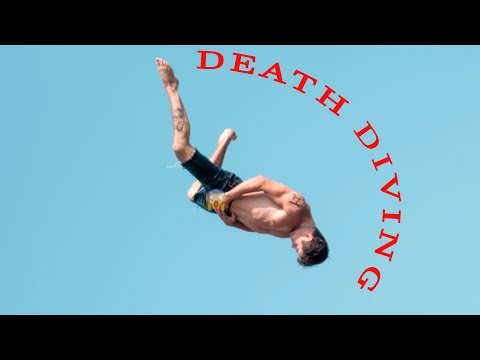
Best Of Death Diving ( Døds Championship Denmark )
YouTube · Mr Lowe +
Pages
On this page
Sport on Earth › Sports
Sport on Earth · Sport
Springboard and platform diving, scored on difficulty and execution.
News stories from around the world, gathered and sourced by the Sport on Earth desk.
Diving is carried on the program for World Aquatics Championships 2027 (Diving), 26 June – 4 July 2027, in Budapest, Hungary. Springboard and platform diving, scored on difficulty and execution. The desk carries the sport’s full record — guide, calendar and history — on its own page.
World Aquatics · Nov 2026
Diving is carried on the program for Los Angeles 2028 Olympic Games, 14 – 30 July 2028, in Los Angeles, USA. Springboard and platform diving, scored on difficulty and execution. The desk carries the sport’s full record — guide, calendar and history — on its own page.
LA28 / IOC · Nov 2026
Written by Sport on Earth’s journalists — columns, features and interviews from the desk.
No columns or stories filed for this sport yet.
Everything the desk has published for Diving, organised by section.
From the News Desk · all news, every sport →
Every embed below was verified playable before listing — the network’s standing rule.
YouTube · Mr Lowe +
Diving is carried on the program for World Aquatics Championships 2027 (Diving), 26 June – 4 July 2027, in Budapest, Hungary. Springboard and platform diving, scored on difficulty and execution. The desk carries the sport’s full record — guide, calendar and history — on its own page.
World Aquatics · Nov 2026
Diving is carried on the program for Los Angeles 2028 Olympic Games, 14 – 30 July 2028, in Los Angeles, USA. Springboard and platform diving, scored on difficulty and execution. The desk carries the sport’s full record — guide, calendar and history — on its own page.
LA28 / IOC · Nov 2026
Pages
On this page
No game on this site is made specifically for Diving yet. The games below are the site's all-sport games, which honestly cover every sport — nothing from another sport has been dressed up as this sport's game.
A new set of questions every day, across every sport this site covers.
Real-athlete Top Sport on Earth decks built from the site’s verified board data.
Diving's lab is the Physics Lab section on this page — the applied physics of its sport family, with a computed interactive where one honestly fits.
Physics Arena — the general biomechanics & physics teaching sandbox, shared by every sport.
The homepage sport explorer also carries a general Lab tab of small interactive experiments.
Calendar data not yet carried for Diving — this site does not yet hold schedule data for it, so no dates are shown rather than invented.
Which item should we follow up?
Votes are counted on the Sport on Earth server and the totals shown are every reader’s votes; your own choice is remembered in this browser.
Dated news entries for x163, newest first, dates exactly as carried in the site’s news data.
The flagship competitions on the calendar, with the dates for the current/upcoming cycle. Every date below was verified against the named source on 1 November 2026; dates change, and the source is the authority.
| Event | Dates | Where | Source |
|---|---|---|---|
| World Aquatics Championships 2027 (Diving) | 26 June – 4 July 2027 | Budapest, Hungary | World Aquatics — Budapest 2027 competition schedule |
| Los Angeles 2028 Olympic Games | 14 – 30 July 2028 | Los Angeles, USA | LA28 / IOC — Games dates |
Water’s density (about 1,000 kg/m³ against air’s 1.225) makes every physics effect enormous: drag grows with the square of speed, so small gains in streamlining beat large gains in strength. The calculator below runs the drag model with water as the default medium and assumptions printed.
Propulsion is the mirror image: the hand, blade or hull pushes water backward, and the reaction pushes the athlete forward (Newton’s third law) — efficient strokes maximise the water ’held’ per stroke (a firm catch) rather than the water slipped. Waves add a second ceiling for displacement craft: a hull’s practical top speed relates to its waterline length, because it must climb its own bow wave.
From this sport's own record: Springboard and platform diving, scored on difficulty and execution. The lab above treats the physics of the sport's family; no measurement specific to this sport is printed, because the site's verified record for it carries none — parameters are never invented to fill a lab.
Model: drag force F = ½·ρ·CdA·v²; power against drag P = F·v. Assumptions: constant drag area, no waves, no rolling or internal resistance — drag only. CdA is the athlete-and-equipment drag area: a tucked cyclist is roughly 0.2–0.3 m²; treat other values as exploration, not measurement.
The general teaching sandbox for every sport is the Physics Arena on the Games page — the same printed models, with a defender added.
The hands-on lab for Diving, built entirely from the record this site carries for it — its documented rolls, its halls, its venues, its calendar and its census family. Every figure below is computed from that carried record at build time; nothing is estimated and nothing is pulled live. The companion Physics Lab on this page works the family's physics; this lab works the record.
Diving carries 1 hall in the site’s record — International Swimming Hall of Fame — with 814 inductees carried, 0 of them with a full verified profile on this site.
Basis: the Hall of Fame record carried on this site — the same rolls and verified profiles the Hall of Fame books print. Inductees a hall lists but the site has not verified stay list-only, exactly as the books state.
The carried global venue dataset holds 7 venues for Diving across 7 countries. The largest capacity the dataset records for this sport is 12,880 — Danube Arena, .
Basis: the global venue dataset carried on this site (6,438 venues with coordinates; the venue explorer on the sports index and the stadium sun table work the same data). Countries beyond the 25 largest are counted in the totals above but not listed here.
Basis: the dated events this entry’s own record carries, as announced by the bodies named in the record. A sport whose record carries no fixed dated calendar says so on its calendar page rather than inventing one.
Computed from the site census: the Water sports family holds 29 entries on this site. Across the family, the carried record includes documented rolls for 0 of them, Hall of Fame data for 6, venue sets for 7, and dated calendars for 9.
Every other entry in the family: Artistic Swimming · Bodyboarding · Bog Snorkelling · Canoe Polo · Canoeing and Kayaking · Cliff Diving · Dragon Boat Racing · Finswimming · Freediving · Kiteboarding · Log Rolling · Ocean Rowing · Outrigger Canoeing · Plunge for Distance · Rowing · Sailing · Spearfishing · Sport Diving · Sport Fishing · Surf Lifesaving · Surfing · Swimming · Underwater Hockey · Underwater Rugby · Water Jousting · Water Polo · Waterball / Water Fights · Waterskiing and Wakeboarding
Basis: the Sport on Earth census itself — the same 460-entry register the census page prints.
The desk has not verified a sponsorship record for Diving from published sources, so none is printed. Sponsorship history is added only when a real published source supports it — sponsor by sponsor, deal by deal. Current sponsorship deals across sport are tracked on the Money Desk sponsorship page.
How this game is played, gathered from the record Sport on Earth already carries for Diving, with the positions taken from the sourced chart cited in that section.
Diving turns a fall into a judged performance: athletes launch from the 3-metre springboard or the 10-metre platform, chain somersaults and twists, and are scored on how cleanly they disappear into the water.
It has been an Olympic sport since 1904 and sits inside World Aquatics alongside swimming — Sport on Earth’s cliff diving page covers the high-diving extreme; this page covers the pool sport itself.
How diving is scored — the rules as this site's record carries them:
Diving has no fixed positions — its format designates no positional roles.
Format as carried in hidden_files/batchB-nov1/batchb_data.json: "Springboard and platform diving, scored on difficulty and execution." The format carries no designated positional roles. (Source: Sport on Earth carried sport record.)
Its Tactics & Strategy book — its opening entries, the basic plays, are:
The full book carries 7 entries — in this page’s Playbook / Tactics & Strategy section, and at the Playbooks hub.
Sport on Earth's own analytics: every figure in this panel is computed at build time from the record this site itself carries, with the source named. No outside data is used, and no betting figures of any kind.
Venues carried: 7 in 7 countries; the largest carried capacity is 12,880 (Danube Arena).
Source: the site's global venue record (venues-global.json); a capacity is printed only where the record carries a verified one.
Census arithmetic: Diving sits in the water sports family — 29 census sports, of which 0 carry a qualifying champions roll in the site's record.
Diving turns a fall into a judged performance: athletes launch from the 3-metre springboard or the 10-metre platform, chain somersaults and twists, and are scored on how cleanly they disappear into the water.
It has been an Olympic sport since 1904 and sits inside World Aquatics alongside swimming — Sport on Earth’s cliff diving page covers the high-diving extreme; this page covers the pool sport itself.
The flagship circuit is the World Aquatics Diving World Cup, with the World Aquatics Championships and the Olympics as the peak events.
China’s national team — the ’Dream Team’ — has dominated the sport for four decades, sweeping all eight Olympic golds at Paris 2024.
Synchronised diving, pairs performing identical dives in unison, joined the Olympic program in 2000.
Sport on Earth carries no diving results feed — no results or rankings are published here; this page is the verified record of the sport.
Sources, verified November 1, 2026: World Aquatics — Diving · Olympics.com — Diving
How the laws of Diving are governed today — the documented record, stated plainly.
Diving is governed by World Aquatics under a framework whose real law is the degree-of-difficulty table: every dive carries a DD tariff computed from its formula components, judges score execution, and the table is revised by technical committees between cycles — continuous calibrated governance (the same architecture artistic swimming borrowed). No single dated landmark law change is carried for diving.
That framework summary is the whole documented record Sport on Earth can verify for this sport — no major dated rule changes are carried, rather than invent any.
Source basis: The governing body’s published framework as summarised in this section (see the framework text).
Sport on Earth carries no results feed for Diving: no scores or fixtures are published here, rather than inventing them. The sport's documented record is in its history page and the History & Records section of this page.
The historical record for Diving — past standings, champions, title history and all-time leaders, as deep as verifiable public records go.
Season-by-season standings, historical player statistics and title rolls are not carried for Diving: no public archive publishes them in a form Sport on Earth can verify, and this site does not invent history. What is carried for this sport is its verified record, its rule-change history and its league history — elsewhere on this page.
The review and analysis videos from Diving’s verified video pool — every embed below was identity-checked and probed playable before listing, the site’s standing rule. Nothing here is a show Sport on Earth produces; these are the review, post-game and breakdown videos the pool already carries for this sport.
No verified review-show video is carried for this sport yet.
Chart basis: counts from Sport on Earth’s own carried data files at build time — verified videos carried for this sport (the verified pool: sport-videos.json + the desk league pools), news items carried (news.json), and league pages carried (desk.json). No external or estimated figures.
The filter sorts the Review Room embeds and the picture cards above by the keywords in their carried titles (review / analysis / recap and similar, or highlights). It runs entirely in your browser — nothing is sent anywhere.
Diving is one of the disciplines honoured by the International Swimming Hall of Fame; the full list is carried on the Swimming page and summarised here.
Fort Lauderdale, Florida, United States
814 inductees. The full list is carried on the Swimming page.
Source basis: Wikipedia — "List of members of the International Swimming Hall of Fame" (accessed Nov 1, 2026); parsed mechanically from the article’s published table. Material from Wikipedia is used under CC BY-SA 4.0..
Springboard and platform diving, scored on difficulty and execution.
The format, from this sport's verified record:
📖 Diving — Tactics & Strategy — every entry, plus the arcade strategy, at the foot of this page.
An arcade take on Diving: set the angle, set the power, and land the diver in a clean entry. Five attempts; the closer to the middle, the more it scores. Arcade distances and a training arc — a game in the spirit of the sport, not a simulation of it.
This page’s own game is the arcade above. Everything else on the site that fits this sport is listed here — and anything borrowed from a similar sport is labelled as that sport’s game, never passed off as this one’s.
1 verified documentaries, films and series about this sport are listed in the site's screen guide: Sport on Screen — Diving.
The tools on this site that honestly run on Diving — its own record first, then the site-wide general tools that apply. The full Diving toolkit prints the ones that do not apply, with the data reason why.
Site-wide tools, not built for Diving alone: Tournament Planner · My Notebook · The Labs · Design Studio · The Makers’ Bench · Match Day Desk · Play It Near You · Myth-Check Desk · Governing Bodies · Heat & Safety Calculator (WBGT) · Hydration Calculator · Training-Load Planner · Game Clock & Timer · Custom Rulebook Generator · Scout Notes Parser.
Tactics & Strategy — this sport’s book
diving’s book — the dive list is a program constructed like a gymnastics routine: degree of difficulty against certainty, managed across six or eleven dives.
7 entries, plus the arcade strategy below. All wording is original coaching-vocabulary prose; nothing is copied from any proprietary playbook.
A diver’s list balances degree of difficulty (DD) against execution: a moderate dive performed perfectly outscores a hard one performed adequately, and the list’s construction is the coach’s first tactic of the meet.
When it’s used: The list is a portfolio: risk is allocated across the rounds like rounds in a series.
The sequence
The springboard’s hurdle loads the board like a spring: the dive’s height — and therefore its time for rotations — is bought in the hurdle’s timing with the board’s recoil.
When it’s used: The board is a partner with a spring’s temper: the hurdle is how you ask it for height.
The sequence
The dive is judged at both ends — but the entry is its signature: the ’rip’ entry, hands tearing the water so the body follows through the same hole, is the sound (and near-absence of splash) the judges reward first.
When it’s used: The rip is an entry that erases itself: the perfect dive leaves no evidence.
The sequence
From 27 metres (20 for women), cliff diving adds the feet-first entry, the barani and the in-flight calculations of a three-second fall — and a safety team in the water as part of the event’s formation.
When it’s used: Three seconds of fall: the dive is planned like a flight, because it is one.
The sequence
Two divers, one dive, judged also on their synchronisation: the pair’s craft is the identical hurdle, the matched take-off and a shared count that survives the crowd’s noise.
When it’s used: Synchro is a doubles game where the ball is gravity and both players must hit it identically.
The sequence
The diving family’s formats share its pages between the springboard’s timing and the platform’s courage: the 10-metre event’s entries are at highway speed and its lists are priced accordingly, and the mixed synchro events have added the pair’s combined list to the book.
When it’s used: The platform is not a higher springboard; it is a different sport sharing a pool.
The sequence
Diving is judged on the whole arc with the entry as its loudest word: the judges’ craft (watching the flight’s phases in order, discounting the splash’s theatre for the body’s alignment) is a trained literacy the sport teaches its officials like a language.
When it’s used: The splash is evidence, not verdict: the judges are trained to read the body through it.
The sequence
The arcade cell · strategy
This page’s arcade cell: launch the diver at a clean entry from off the board · 36 m (arcade scale). Angle, power, launch — five attempts, and the cell keeps your best.
When it’s used: On this page, in the Play section — and its strategy is the same craft as the book above it, miniaturised.
The sequence
Part of the Sport on Earth Playbooks — a book for every sport and every game on the site.
Behind the Play · Full treatment — from this sport’s own record
Springboard and platform diving, scored on difficulty and execution.
Behind the Play takes the decisive actions of Diving apart: how the scoring play is built, which patterns the players are really running, and which rules remade the play into its modern shape.
The format, from this sport's verified record:
Source basis: this sport’s carried record on this page (verified record, rule-changes dossier, history datasets) and the play patterns of its family as written in the site’s guides. Nothing here is invented.