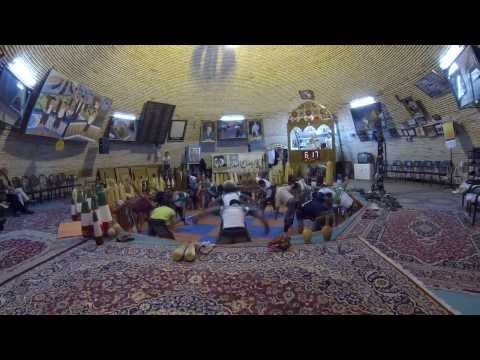
► Pt. 2/3 - Best Zurkhaneh in Yazd IRAN - يزد زور خانه, ورزش پهلوانی
YouTube · Masihi Rantanplan
Pages
On this page
Sport on Earth › Sports
Sport on Earth · Sport
Iran’s ’house of strength’: athletes swing great wooden clubs and lift stone shields in a sunken pit, to drum, bell and sung poetry.
Every embed below was verified playable before listing — the network’s standing rule.
YouTube · Masihi Rantanplan
Pages
On this page
No game on this site is made specifically for Zurkhaneh yet. The games below are the site's all-sport games, which honestly cover every sport — nothing from another sport has been dressed up as this sport's game.
A new set of questions every day, across every sport this site covers.
Real-athlete Top Sport on Earth decks built from the site’s verified board data.
Zurkhaneh's lab is the Physics Lab section on this page — the applied physics of its sport family, with a computed interactive where one honestly fits.
Physics Arena — the general biomechanics & physics teaching sandbox, shared by every sport.
The homepage sport explorer also carries a general Lab tab of small interactive experiments.
Calendar data not yet carried for Zurkhaneh — this site does not yet hold schedule data for it, so no dates are shown rather than invented.
Which section of this page should we expand first?
Votes are counted on the Sport on Earth server and the totals shown are every reader’s votes; your own choice is remembered in this browser.
How this game is played, gathered from the record Sport on Earth already carries for Zurkhaneh, with the positions taken from the sourced chart cited in that section.
Zurkhaneh — varzesh-e bastani, ’the ancient sport’ — is Iran’s traditional martial and strength discipline, practised in a domed gymnasium (the zurkhaneh, ’house of strength’) around a sunken octagonal pit, the gowd. Athletes train to the beat of the morshed’s drum and bell with wooden clubs (mil), shields (sang), iron chains and push-up boards, in rituals blending exercise, music, poetry and chivalric ethics that reach back centuries.
UNESCO inscribed the Pahlevani and Zoorkhaneh rituals in 2010 as Intangible Cultural Heritage. Iran’s zurkhaneh federation organises modern competition in the traditional exercises, and the practice has spread internationally as both heritage and sport.
The practice — the rules as this site's record carries them:
Zurkhaneh has no fixed positions — its format designates no positional roles.
Format as carried in hidden_files/batchB-nov1/batchb_data.json: "Iran’s ’house of strength’: athletes swing great wooden clubs and lift stone shields in a sunken pit, to drum, bell and sung poetry." The format carries no designated positional roles. (Source: Sport on Earth carried sport record.)
Sport on Earth's own analytics: every figure in this panel is computed at build time from the record this site itself carries, with the source named. No outside data is used, and no betting figures of any kind.
Census arithmetic: Zurkhaneh sits in the strength sports family — 17 census sports, of which 2 carry a qualifying champions roll in the site's record.
The carried record for Zurkhaneh is too thin for computed panels: no champions roll, hall-of-fame list or venue record is carried for it. This panel therefore prints the census arithmetic only — the honest answer rather than a manufactured figure.
Sport on Earth does not yet hold verified dated events for Zurkhaneh, and its carried record does not state the season's timing in words — so no calendar is shown rather than an invented one. What the site does carry for this sport is on this page: its verified record, its rules record and its history.
A lift is a lever problem: the bar’s load creates a turning effect (torque = load × horizontal distance from the joint) that the muscles must beat, and the lift is hardest where that distance peaks — the sticking point. The calculator below computes the torque for a load at a chosen moment arm, and the mechanical work of raising it through a chosen height (work = m·g·h), with assumptions printed.
Bar path is the visible record of those torques: elite lifters keep the bar close to the body’s joints to shrink moment arms, which is the whole physics of ’technique’ in strength sport.
From this sport's own record: Iran’s ’house of strength’: athletes swing great wooden clubs and lift stone shields in a sunken pit, to drum, bell and sung poetry. The lab above treats the physics of the sport's family; no measurement specific to this sport is printed, because the site's verified record for it carries none — parameters are never invented to fill a lab.
Model: torque τ = m·g·(moment arm); mechanical work W = m·g·h, g = 9.81 m/s². Assumptions: static load, horizontal moment arm — a real lift's moment arm changes through the movement, which is exactly why lifts have sticking points.
The general teaching sandbox for every sport is the Physics Arena on the Games page — the same printed models, with a defender added.
The hands-on lab for Zurkhaneh, built entirely from the record this site carries for it — its documented rolls, its halls, its venues, its calendar and its census family. Every figure below is computed from that carried record at build time; nothing is estimated and nothing is pulled live. The companion Physics Lab on this page works the family's physics; this lab works the record.
The honest position: the record this site carries for Zurkhaneh is thin — no documented roll, hall, venue set or dated calendar is carried for it yet — so this entry’s lab is its family lab: the computed census of the family it belongs to. When the record grows, the lab grows with it; nothing here is estimated to fill the space.
Computed from the site census: the Strength sports family holds 17 entries on this site. Across the family, the carried record includes documented rolls for 2 of them, Hall of Fame data for 1, venue sets for 1, and dated calendars for 1.
Every other entry in the family: Armwrestling · Arranca Mandioca · Bodybuilding · Gaffelhangen / Pitchfork Hanging · Hay Toss · Herri Kirolak · Highland Games · Insuknawr · Kettlebell lifting · Mas-Wrestling · Palo Encebado · Strongman and Powerlifting · The Tactical Games · Timbersports · Tug of War · Weightlifting
Basis: the Sport on Earth census itself — the same 460-entry register the census page prints.
The desk has not verified a sponsorship record for Zurkhaneh from published sources, so none is printed. Sponsorship history is added only when a real published source supports it — sponsor by sponsor, deal by deal. Current sponsorship deals across sport are tracked on the Money Desk sponsorship page.
Zurkhaneh — varzesh-e bastani, ’the ancient sport’ — is Iran’s traditional martial and strength discipline, practised in a domed gymnasium (the zurkhaneh, ’house of strength’) around a sunken octagonal pit, the gowd. Athletes train to the beat of the morshed’s drum and bell with wooden clubs (mil), shields (sang), iron chains and push-up boards, in rituals blending exercise, music, poetry and chivalric ethics that reach back centuries.
UNESCO inscribed the Pahlevani and Zoorkhaneh rituals in 2010 as Intangible Cultural Heritage. Iran’s zurkhaneh federation organises modern competition in the traditional exercises, and the practice has spread internationally as both heritage and sport.
UNESCO’s inscription decision (nomination file No. 00378) describes the ritual precisely. Pahlevani is a ritual collection of gymnastic and callisthenic movements performed by ten to twenty men, each wielding instruments symbolizing ancient weapons, inside the Zoorkhane — a sacred domed structure with an octagonal sunken arena and audience seats. The Morshed who leads the ritual performs epic and Gnostic poems and beats out time on a zarb goblet drum; the poems transmit ethical and social teachings and form part of Zoorkhanei literature, a blend UNESCO describes as combining elements of Islam, Gnosticism and ancient Persian beliefs.
The decision also gives the practice’s scale at inscription: 500 Zoorkhanes across Iran, each comprising practitioners, founders and a number of Pīshkesvats. Participants may be drawn from any social strata or religious background, and each group has strong ties to its local community, working to assist those in need — grounds on which the committee found the rituals contribute to social cohesion and solidarity while transcending differences in age and religion.
UNESCO’s decision records the tradition’s internal ladder: students are instructed in ethical and chivalrous values under a Pīshkesvat (champion), and those who master the skills, observe religious principles and pass the ethical stages may acquire the rank of Pahlevanī — ’hero’ — denoting rank and authority within the community. The rituals had been transmitted over many generations and were already entered in Iran’s National Inventory, maintained by the Iranian Cultural Heritage, Handicrafts and Tourism Organization, before inscription.
Inscribed by UNESCO in 2010 (Pahlevani and Zoorkhaneh rituals) as Intangible Cultural Heritage.
Practised in the gowd, a sunken octagonal pit, to a leader’s drum and bell.
Signature implements: the mil clubs, sang shields and the kabbadeh iron chain.
UNESCO nomination file No. 00378 covers the Pahlevani and Zoorkhanei rituals.
A ritual session involves ten to twenty men performing with instruments symbolizing ancient weapons.
At inscription, UNESCO recorded 500 Zoorkhanes across Iran.
The morshed leads on a zarb goblet drum, reciting epic and Gnostic poems that carry ethical and social teachings.
Zurkhaneh has no structured results feed this site can carry, so this page is the verified record only — the tradition, its pit and its UNESCO-listed practice as verified in November 2026 — with no live results.
Sources, verified November 1, 2026: Zurkhaneh · UNESCO Intangible Cultural Heritage — Decision of the Intergovernmental Committee 5.COM 6.20 (Pahlevani and Zoorkhanei rituals)
Material from Wikipedia linked above is used under CC BY-SA 4.0.
How the laws of Zurkhaneh are governed today — the documented record, stated plainly.
Zurkhaneh is governed by Iran’s federation under rules codifying the traditional exercises for competition, within the UNESCO-recognised ritual frame. No major dated rule change is carried for zurkhaneh.
That framework summary is the whole documented record Sport on Earth can verify for this sport — no major dated rule changes are carried, rather than invent any.
Source basis: The governing body’s published framework as summarised in this section (see the framework text).
Sport on Earth carries no results feed for Zurkhaneh: no scores or fixtures are published here, rather than inventing them. The sport's documented record is in its history page and the History & Records section of this page.
The historical record for Zurkhaneh — past standings, champions, title history and all-time leaders, as deep as verifiable public records go.
Season-by-season standings, historical player statistics and title rolls are not carried for Zurkhaneh: no public archive publishes them in a form Sport on Earth can verify, and this site does not invent history. What is carried for this sport is its verified record, its rule-change history and its league history — elsewhere on this page.
The review and analysis videos from Zurkhaneh’s verified video pool — every embed below was identity-checked and probed playable before listing, the site’s standing rule. Nothing here is a show Sport on Earth produces; these are the review, post-game and breakdown videos the pool already carries for this sport.
No verified review-show video is carried for this sport yet.
The filter sorts the Review Room embeds and the picture cards above by the keywords in their carried titles (review / analysis / recap and similar, or highlights). It runs entirely in your browser — nothing is sent anywhere.
No hall of fame with a published inductee list is carried for Zurkhaneh. Sport on Earth does not invent halls or inductees: where a recognised hall publishes its list in a form this site can carry, the full list will appear here with its source named.
Iran’s ’house of strength’: athletes swing great wooden clubs and lift stone shields in a sunken pit, to drum, bell and sung poetry.
The format, from this sport's verified record:
The Zurkhaneh record book is still thin: beyond the standings, rules and calendar layers on this page, no verified winners roll or honours list is carried yet. The desk adds record material only when a published source can be named for it — never from memory or invention.
More from the desk: the expert guide to Zurkhaneh · the site-wide Writing Desk · every sport on Earth.
An arcade take on Zurkhaneh: set the angle, set the power, and land the shot in the sector. Five attempts; the closer to the middle, the more it scores. Arcade distances and a training arc — a game in the spirit of the sport, not a simulation of it.
This page’s own game is the arcade above. Everything else on the site that fits this sport is listed here — and anything borrowed from a similar sport is labelled as that sport’s game, never passed off as this one’s.
The tools on this site that honestly run on Zurkhaneh — its own record first, then the site-wide general tools that apply. The full Zurkhaneh toolkit prints the ones that do not apply, with the data reason why.
No bench tool yet computes from Zurkhaneh’s own carried record — the general tools below are the ones that honestly apply.
Site-wide tools, not built for Zurkhaneh alone: Tournament Planner · My Notebook · The Labs · Design Studio · The Makers’ Bench · Match Day Desk · Play It Near You · Myth-Check Desk · Governing Bodies · Heat & Safety Calculator (WBGT) · Hydration Calculator · Training-Load Planner · Game Clock & Timer · Custom Rulebook Generator · Scout Notes Parser.
Behind the Play · Full treatment — from this sport’s own record
Iran’s ’house of strength’: athletes swing great wooden clubs and lift stone shields in a sunken pit, to drum, bell and sung poetry.
Behind the Play takes the decisive actions of Zurkhaneh apart: how the scoring play is built, which patterns the players are really running, and which rules remade the play into its modern shape.
The format, from this sport's verified record:
Source basis: this sport’s carried record on this page (verified record, rule-changes dossier, history datasets) and the play patterns of its family as written in the site’s guides. Nothing here is invented.