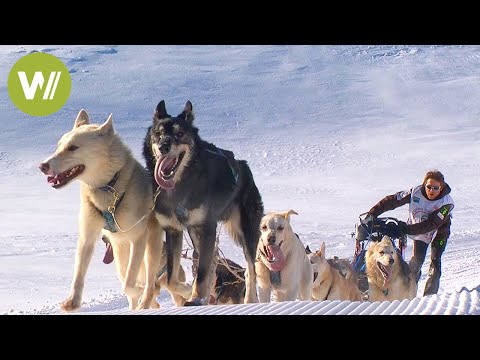
Sled dog race in French Alps: La Grande Odyssée Savoie Mont Blanc
YouTube · wocomoWILDLIFE
Pages
On this page
Sport on Earth › Sports
Sport on Earth · Sport
Endurance mushing, including the Iditarod.
Every embed below was verified playable before listing — the network’s standing rule.
YouTube · wocomoWILDLIFE
Pages
On this page
No game on this site is made specifically for Sled Dog Racing yet. The games below are the site's all-sport games, which honestly cover every sport — nothing from another sport has been dressed up as this sport's game.
A new set of questions every day, across every sport this site covers.
Real-athlete Top Sport on Earth decks built from the site’s verified board data.
Sled Dog Racing's lab is the Physics Lab section on this page — the applied physics of its sport family, with a computed interactive where one honestly fits.
Physics Arena — the general biomechanics & physics teaching sandbox, shared by every sport.
The homepage sport explorer also carries a general Lab tab of small interactive experiments.
Calendar data not yet carried for Sled Dog Racing — this site does not yet hold schedule data for it, so no dates are shown rather than invented.
Which section of this page should we expand first?
Votes are counted on the Sport on Earth server and the totals shown are every reader’s votes; your own choice is remembered in this browser.
Sport on Earth does not yet hold verified dated events for Sled Dog Racing, and its carried record does not state the season's timing in words — so no calendar is shown rather than an invented one. What the site does carry for this sport is on this page: its verified record, its rules record and its history.
Animal sports run on quadruped biomechanics: gaits are repeating patterns of footfalls that trade stability for speed, and at the gallop the spine itself flexes and extends as part of the stride. Loads are large and measurable — a horse’s foreleg can carry well over its body’s weight at gallop, which is why conditioning is gradual and surfaces matter.
Jumping efforts are projectile motion for the combined horse-and-rider (or dog) system: take-off speed and angle set the arc, and the bascule — the rounded shape over a fence — is the body arranging itself around that arc. Sport on Earth offers an explainer here rather than a calculator: the honest inputs (take-off speeds, masses) vary by animal and are not carried in this sport’s verified record, so no numbers are printed that the record cannot back.
From this sport's own record: Endurance mushing, including the Iditarod. The lab above treats the physics of the sport's family; no measurement specific to this sport is printed, because the site's verified record for it carries none — parameters are never invented to fill a lab.
No calculator is offered for this sport — honestly, none fits without inventing parameters. The site's general Physics Arena remains the hands-on sandbox, with every formula printed.
The general teaching sandbox for every sport is the Physics Arena on the Games page — the same printed models, with a defender added.
The hands-on lab for Sled Dog Racing, built entirely from the record this site carries for it — its documented rolls, its halls, its venues, its calendar and its census family. Every figure below is computed from that carried record at build time; nothing is estimated and nothing is pulled live. The companion Physics Lab on this page works the family's physics; this lab works the record.
The honest position: the record this site carries for Sled Dog Racing is thin — no documented roll, hall, venue set or dated calendar is carried for it yet — so this entry’s lab is its family lab: the computed census of the family it belongs to. When the record grows, the lab grows with it; nothing here is estimated to fill the space.
Computed from the site census: the Animal sports family holds 23 entries on this site. Across the family, the carried record includes documented rolls for 0 of them, Hall of Fame data for 3, venue sets for 5, and dated calendars for 1.
Every other entry in the family: Audaryspak · Camel Racing · Carrera de Cintas · Charrería · Dog Agility · Equestrian · Flyball · Furusiyya · Greyhound Racing · Horse Racing · Horseball · Kambala · Kok-Boru · Pack Burro Racing · Pato · Pigeon Racing · Polo · Polocrosse · Puppy Bowl · Rodeo and Bull Riding · Sheepdog Trials · Tent Pegging
Basis: the Sport on Earth census itself — the same 460-entry register the census page prints.
The desk has not verified a sponsorship record for Sled Dog Racing from published sources, so none is printed. Sponsorship history is added only when a real published source supports it — sponsor by sponsor, deal by deal. Current sponsorship deals across sport are tracked on the Money Desk sponsorship page.
How this game is played, gathered from the record Sport on Earth already carries for Sled Dog Racing, with the positions taken from the sourced chart cited in that section.
Sport on Earth carries no separate rules list for Sled Dog Racing; the governing framework its record carries is this:
Sled dog racing is governed by the IFSS for championship racing and by its famous races’ own codes (the Iditarod’s rules — mandatory gear, dog-care and rest provisions tightened across decades of welfare scrutiny — being the most consequential, and amended by edition rather than by one canonical date). No single dated change is carried for sled dog racing.
Positions for Sled Dog Racing are not yet sourced on Sport on Earth: no verified positions chart has been carried for this sport yet, so none is shown here rather than an invented one. That says nothing about whether the sport has positions — only that they have not been sourced for this page yet.
Its Tactics & Strategy book — its opening entries, the basic plays, are:
The full book carries 7 entries — in this page’s Playbook / Tactics & Strategy section, and at the Playbooks hub.
Sport on Earth's own analytics: every figure in this panel is computed at build time from the record this site itself carries, with the source named. No outside data is used, and no betting figures of any kind.
Census arithmetic: Sled Dog Racing sits in the animal sports family — 23 census sports, of which 1 carry a qualifying champions roll in the site's record.
The carried record for Sled Dog Racing is too thin for computed panels: no champions roll, hall-of-fame list or venue record is carried for it. This panel therefore prints the census arithmetic only — the honest answer rather than a manufactured figure.
How the laws of Sled Dog Racing are governed today — the documented record, stated plainly.
Sled dog racing is governed by the IFSS for championship racing and by its famous races’ own codes (the Iditarod’s rules — mandatory gear, dog-care and rest provisions tightened across decades of welfare scrutiny — being the most consequential, and amended by edition rather than by one canonical date). No single dated change is carried for sled dog racing.
That framework summary is the whole documented record Sport on Earth can verify for this sport — no major dated rule changes are carried, rather than invent any.
Source basis: The governing body’s published framework as summarised in this section (see the framework text).
Sport on Earth carries no results feed for Sled Dog Racing: no scores or fixtures are published here, rather than inventing them. The sport's documented record is in its history page and the History & Records section of this page.
The historical record for Sled Dog Racing — past standings, champions, title history and all-time leaders, as deep as verifiable public records go.
Season-by-season standings, historical player statistics and title rolls are not carried for Sled Dog Racing: no public archive publishes them in a form Sport on Earth can verify, and this site does not invent history. What is carried for this sport is its verified record, its rule-change history and its league history — elsewhere on this page.
The review and analysis videos from Sled Dog Racing’s verified video pool — every embed below was identity-checked and probed playable before listing, the site’s standing rule. Nothing here is a show Sport on Earth produces; these are the review, post-game and breakdown videos the pool already carries for this sport.
No verified review-show video is carried for this sport yet.
The filter sorts the Review Room embeds and the picture cards above by the keywords in their carried titles (review / analysis / recap and similar, or highlights). It runs entirely in your browser — nothing is sent anywhere.
No hall of fame with a published inductee list is carried for Sled Dog Racing. Sport on Earth does not invent halls or inductees: where a recognised hall publishes its list in a form this site can carry, the full list will appear here with its source named.
Endurance mushing, including the Iditarod.
In the wider animal family of sports — four-legged locomotion and the jumping effort, the game turns on: The animal is an athlete: fitness, soundness and mood are monitored daily and outrank any calendar date.; Communication is trained, not assumed: aids and signals are installed gradually until they are invisible.; Course knowledge: walking or studying the course beforehand is part of performance in jumping, racing and driving.; Recovery and care decide careers: longevity in animal sports is built in the yard, not the arena.; Breeding is long-term tactics: bloodlines are selected generations ahead for the traits a discipline rewards — soundness first among them.; The warm-up is veterinary: gait, breathing and demeanour are checked before competition, and horsemen and handlers scratch animals the public never hears about..
Sport on Earth carries no team or player directory for this sport, because no structured public feed publishes a verifiable one. What is carried is the documented record on this page — history, rules, honours and the calendar — each with its source named.
The Sled Dog Racing record book is still thin: beyond the standings, rules and calendar layers on this page, no verified winners roll or honours list is carried yet. The desk adds record material only when a published source can be named for it — never from memory or invention.
More from the desk: the expert guide to Sled Dog Racing · the site-wide Writing Desk · every sport on Earth.
📖 Sled Dog Racing — Tactics & Strategy — every entry, plus the arcade strategy, at the foot of this page.
An arcade take on Sled Dog Racing: set the angle, set the power, and land the lasso in the post. Five attempts; the closer to the middle, the more it scores. Arcade distances and a training arc — a game in the spirit of the sport, not a simulation of it.
This page’s own game is the arcade above. Everything else on the site that fits this sport is listed here — and anything borrowed from a similar sport is labelled as that sport’s game, never passed off as this one’s.
The tools on this site that honestly run on Sled Dog Racing — its own record first, then the site-wide general tools that apply. The full Sled Dog Racing toolkit prints the ones that do not apply, with the data reason why.
No bench tool yet computes from Sled Dog Racing’s own carried record — the general tools below are the ones that honestly apply.
Site-wide tools, not built for Sled Dog Racing alone: Tournament Planner · My Notebook · The Labs · Design Studio · The Makers’ Bench · Match Day Desk · Play It Near You · Myth-Check Desk · Governing Bodies · Heat & Safety Calculator (WBGT) · Hydration Calculator · Training-Load Planner · Game Clock & Timer · Custom Rulebook Generator · Scout Notes Parser.
Tactics & Strategy — this sport’s book
the animal racing family’s shared book — greyhounds, racing pigeons and sled dogs: three species, three different races, one craft of conditioning, draws and weather.
7 entries, plus the arcade strategy below. All wording is original coaching-vocabulary prose; nothing is copied from any proprietary playbook.
The greyhound’s trap (starting box) and the track’s bias are its geography: railers and wide runners have their lanes by nature, the first bend is the race’s argument, and the draw is priced like a horse race’s stall.
When it’s used: The greyhound’s racing line is bred and drawn, in that order.
The sequence
The racing pigeon navigates home by sun, magnetics and memory over hundreds of kilometres: the fancier’s craft is the bird’s condition, the basketing’s timing, and the liberation’s weather call — the race is won in the loft across a season, and on the day it is won by the wind.
When it’s used: The pigeon’s velocity is computed from the liberation to the clock’s strike: the race’s times are a weather map made legible.
The sequence
The sled dog team is an engine of individuals: leaders (who take the commands and set the line), swing dogs, team dogs and wheelers (the strongest, nearest the sled) — the musher builds the string like a crew builds a boat, and the race’s tactics are rest schedules and the trail’s reading.
When it’s used: The lead dog is the team’s navigator and its captain: the musher’s commands are a vocabulary the leaders learn like a sheepdog’s whistles.
The sequence
Across the family, the athlete cannot speak: the conditioning, feeding and rest are read from the animal’s body by hands and eyes — the handler’s craft is the family’s shared profession, audited by vets and by results.
When it’s used: The animal athlete’s form is read, not reported: the family’s books are all written in that literacy.
The sequence
Greyhound meetings are abandoned for frozen tracks, pigeon races are held for storms by liberators who answer for the birds, and sled dog races are stopped for warm snow and for cold beyond the dogs’ safety: the animal family’s fixtures all carry the weather’s veto, exercised for athletes who cannot decline.
When it’s used: The liberation committee and the track vet share one duty: the animal does not choose to race today.
The sequence
The distance races are run checkpoint to checkpoint: the musher’s schedule (run/rest ratios, where the mandatory rests are banked) is written before the start and revised by the trail — and the dogs’ appetite is the whole plan’s fuel gauge.
When it’s used: A dog team that will not eat will not finish: the musher’s first job is catering at -30.
The sequence
At every distance checkpoint the vets examine the team: hydration, gait, attitude — a dog dropped from the string rides in the sled’s basket to the next checkpoint, and a team the vets stop is stopped. The musher’s race is run inside the vets’ authority, and the sport defends that as its proudest rule.
When it’s used: The dropped dog in the basket is the distance race’s most eloquent image: the engine carries its own.
The sequence
The arcade cell · strategy
This page’s arcade cell: launch the lasso at the post from at roping range · 36 m (arcade scale). Angle, power, launch — five attempts, and the cell keeps your best.
When it’s used: On this page, in the Play section — and its strategy is the same craft as the book above it, miniaturised.
The sequence
Part of the Sport on Earth Playbooks — a book for every sport and every game on the site.
Behind the Play · From the carried record
Endurance mushing, including the Iditarod.
Behind the Play takes the decisive actions of Sled Dog Racing apart: how the scoring play is built, which patterns the players are really running, and which rules remade the play into its modern shape.
Source basis: this sport’s carried record on this page (verified record, rule-changes dossier, history datasets) and the play patterns of its family as written in the site’s guides. Nothing here is invented.