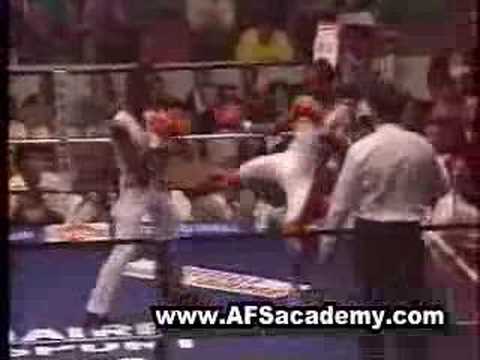
Savate Highlights
YouTube · jebu23
Pages
On this page
Sport on Earth › Sports
Sport on Earth · Sport
French boxing: a full-contact combat sport combining western boxing punches with kicks delivered exclusively with the feet, in shoes.
Every embed below was verified playable before listing — the network’s standing rule.
YouTube · jebu23
Pages
On this page
No game on this site is made specifically for Savate yet. The games below are the site's all-sport games, which honestly cover every sport — nothing from another sport has been dressed up as this sport's game.
A new set of questions every day, across every sport this site covers.
Real-athlete Top Sport on Earth decks built from the site’s verified board data.
Savate's lab is the Physics Lab section on this page — the applied physics of its sport family, with a computed interactive where one honestly fits.
Physics Arena — the general biomechanics & physics teaching sandbox, shared by every sport.
The homepage sport explorer also carries a general Lab tab of small interactive experiments.
Calendar data not yet carried for Savate — this site does not yet hold schedule data for it, so no dates are shown rather than invented.
Which section of this page should we expand first?
Votes are counted on the Sport on Earth server and the totals shown are every reader’s votes; your own choice is remembered in this browser.
Sport on Earth does not yet hold verified dated events for Savate, and its carried record does not state the season's timing in words — so no calendar is shown rather than an invented one. What the site does carry for this sport is on this page: its verified record, its rules record and its history.
A strike’s effect is impulse: force applied over contact time, changing momentum (mass × velocity). The calculator below computes momentum and kinetic energy for a moving mass at a chosen speed — the two numbers behind every conversation about power. Real strikes add the effective mass of the body behind the limb, which is why technique (putting body mass into the blow) out-punches arm speed alone.
Throws and takedowns are rotation: a small force applied far from the opponent’s centre of mass produces a large turning effect (torque), which is why grips at the sleeve, collar or leg unbalance opponents who are stronger in a straight line. Grappling defence is the reverse — widen the base, lower the centre of mass, deny the lever.
From this sport's own record: French boxing: a full-contact combat sport combining western boxing punches with kicks delivered exclusively with the feet, in shoes. The lab above treats the physics of the sport's family; no measurement specific to this sport is printed, because the site's verified record for it carries none — parameters are never invented to fill a lab.
Model: momentum p = m·v; kinetic energy KE = ½·m·v². Assumptions: a single rigid mass at one speed — a real strike or throw involves an effective mass larger than the limb alone (the body behind it) and a contact time that decides the peak force. The numbers show the scaling: energy grows with the square of speed, only linearly with mass.
The general teaching sandbox for every sport is the Physics Arena on the Games page — the same printed models, with a defender added.
The hands-on lab for Savate, built entirely from the record this site carries for it — its documented rolls, its halls, its venues, its calendar and its census family. Every figure below is computed from that carried record at build time; nothing is estimated and nothing is pulled live. The companion Physics Lab on this page works the family's physics; this lab works the record.
The carried global venue dataset holds 1 venues for Savate across 1 countries.
Basis: the global venue dataset carried on this site (6,438 venues with coordinates; the venue explorer on the sports index and the stadium sun table work the same data). Countries beyond the 25 largest are counted in the totals above but not listed here.
Computed from the site census: the Combat sports family holds 49 entries on this site. Across the family, the carried record includes documented rolls for 0 of them, Hall of Fame data for 4, venue sets for 10, and dated calendars for 5.
Every other entry in the family: Alysh · Ashirma · Boxing · Brazilian Jiu-Jitsu · Canne de Combat · Capoeira · Chess Boxing · Chidaoba · Donga · Evala · Fencing · Glima · HEMA · Historical Medieval Battle · Inbuan · Ju-Jitsu · Judo · Karate · Karate Combat · Kendo · Khapkagay · Khuresh · Kickboxing · Kokoowa · Kurash · Kureash · Lethwei · Lotta Sardesca · Lucha Canaria · Lucha de Tolete · Lucha del Garrote · Mbor · Mixed Martial Arts · Moraingy · Muay Thai · Pencak Silat · Power Slap · Sambo · Schwingen · Sport Kobudo · Ssireum · Sumo · Taekkyeon · Taekwondo · Tahtib · Tarung Derajat · Wrestling · Wushu
Basis: the Sport on Earth census itself — the same 460-entry register the census page prints.
The desk has not verified a sponsorship record for Savate from published sources, so none is printed. Sponsorship history is added only when a real published source supports it — sponsor by sponsor, deal by deal. Current sponsorship deals across sport are tracked on the Money Desk sponsorship page.
How this game is played, gathered from the record Sport on Earth already carries for Savate, with the positions taken from the sourced chart cited in that section.
Savate, also known as French boxing or French foot fighting, is a French hybrid martial art and full-contact combat sport combining principles of western boxing with a wide variety of kicking techniques. It originated in France in the 17th century, practiced by sailors in the southern port of Marseille, and its modern formalised form is mainly an amalgam of French street fighting techniques from the beginning of the 19th century.
Michel Casseux opened the first establishment in 1825 for a regulated version of the art, and Charles Lecour combined boxing with chausson and savate to create the sport as it is known today. Savate was included as a demonstration sport in the 1924 Olympic Games in Paris, was recognised by the International University Sports Federation in 2008, and the International Savate Federation is its official worldwide ruling body as carried on the page.
The rules — the rules as this site's record carries them:
Savate has no fixed positions — its format designates no positional roles.
Format as carried in hidden_files/batchB-nov1/batchb_data.json: "French boxing: a full-contact combat sport combining western boxing punches with kicks delivered exclusively with the feet, in shoes." The format carries no designated positional roles. (Source: Sport on Earth carried sport record.)
Its Tactics & Strategy book — its opening entries, the basic plays, are:
The full book carries 10 entries — in this page’s Playbook / Tactics & Strategy section, and at the Playbooks hub.
Sport on Earth's own analytics: every figure in this panel is computed at build time from the record this site itself carries, with the source named. No outside data is used, and no betting figures of any kind.
Venues carried: 1 in 1 countries.
Source: the site's global venue record (venues-global.json); a capacity is printed only where the record carries a verified one.
Census arithmetic: Savate sits in the combat sports family — 49 census sports, of which 0 carry a qualifying champions roll in the site's record.
Savate, also known as French boxing or French foot fighting, is a French hybrid martial art and full-contact combat sport combining principles of western boxing with a wide variety of kicking techniques. It originated in France in the 17th century, practiced by sailors in the southern port of Marseille, and its modern formalised form is mainly an amalgam of French street fighting techniques from the beginning of the 19th century.
Michel Casseux opened the first establishment in 1825 for a regulated version of the art, and Charles Lecour combined boxing with chausson and savate to create the sport as it is known today. Savate was included as a demonstration sport in the 1924 Olympic Games in Paris, was recognised by the International University Sports Federation in 2008, and the International Savate Federation is its official worldwide ruling body as carried on the page.
International Savate Federation (FISav) is the official worldwide ruling body of savate, as carried on the page
Savate was included as a demonstration sport in the Olympic Games in Paris in 1924, its only Olympic appearance as carried on the page
Recognised by FISU in 2008, allowing official University World Championships, the first held in Nantes, France in 2010
Count Pierre Baruzy, seen as the father of modern savate, was 11-time Champion of France and its colonies
Charles Charlemont beat English boxer Jerry Driscoll in 1899 with a round-kick (fouetté median) in the eighth round, as carried on the page
Savate has no structured results feed this site can carry, so this page is the verified record only — its International Savate Federation competition levels and rules as verified in November 2026 — with no live results.
Sources, verified November 1, 2026: Savate
Material from Wikipedia linked above is used under CC BY-SA 4.0.
How the laws of Savate are governed today — the documented record, stated plainly.
Savate is governed by the International Savate Federation under the codified boxe française code that descends from the Casseux and Lecour reforms of the 19th century. Changes under that code, across its assaut, pre-combat and combat levels, are refinements rather than dated landmark replacements of the sport. No major dated rule change is carried for savate.
That framework summary is the whole documented record Sport on Earth can verify for this sport — no major dated rule changes are carried, rather than invent any.
Source basis: The governing body’s published framework as summarised in this section (see the framework text).
Sport on Earth carries no results feed for Savate: no scores or fixtures are published here, rather than inventing them. The sport's documented record is in its history page and the History & Records section of this page.
The historical record for Savate — past standings, champions, title history and all-time leaders, as deep as verifiable public records go.
Season-by-season standings, historical player statistics and title rolls are not carried for Savate: no public archive publishes them in a form Sport on Earth can verify, and this site does not invent history. What is carried for this sport is its verified record, its rule-change history and its league history — elsewhere on this page.
The review and analysis videos from Savate’s verified video pool — every embed below was identity-checked and probed playable before listing, the site’s standing rule. Nothing here is a show Sport on Earth produces; these are the review, post-game and breakdown videos the pool already carries for this sport.
No verified review-show video is carried for this sport yet.
The filter sorts the Review Room embeds and the picture cards above by the keywords in their carried titles (review / analysis / recap and similar, or highlights). It runs entirely in your browser — nothing is sent anywhere.
No hall of fame with a published inductee list is carried for Savate. Sport on Earth does not invent halls or inductees: where a recognised hall publishes its list in a form this site can carry, the full list will appear here with its source named.
French boxing: a full-contact combat sport combining western boxing punches with kicks delivered exclusively with the feet, in shoes.
The format, from this sport's verified record:
The Savate record book is still thin: beyond the standings, rules and calendar layers on this page, no verified winners roll or honours list is carried yet. The desk adds record material only when a published source can be named for it — never from memory or invention.
More from the desk: the expert guide to Savate · the site-wide Writing Desk · every sport on Earth.
📖 Savate — Tactics & Strategy — every entry, plus the arcade strategy, at the foot of this page.
An arcade take on Savate: set the angle, set the power, and land the strike in the pad. Five attempts; the closer to the middle, the more it scores. Arcade distances and a training arc — a game in the spirit of the sport, not a simulation of it.
This page’s own game is the arcade above. Everything else on the site that fits this sport is listed here — and anything borrowed from a similar sport is labelled as that sport’s game, never passed off as this one’s.
The tools on this site that honestly run on Savate — its own record first, then the site-wide general tools that apply. The full Savate toolkit prints the ones that do not apply, with the data reason why.
Site-wide tools, not built for Savate alone: Tournament Planner · My Notebook · The Labs · Design Studio · The Makers’ Bench · Match Day Desk · Play It Near You · Myth-Check Desk · Governing Bodies · Heat & Safety Calculator (WBGT) · Hydration Calculator · Training-Load Planner · Game Clock & Timer · Custom Rulebook Generator · Scout Notes Parser.
Tactics & Strategy — this sport’s book
the striking family’s shared book — kickboxing and Muay Thai, karate and its combat league, lethwei, savate, taekkyeon and taekwondo: the arts of the eight limbs, the point strike and the spinning kick, with each art’s signature entries following on its page.
10 entries, plus the arcade strategy below. All wording is original coaching-vocabulary prose; nothing is copied from any proprietary playbook.
Muay Thai fights with fists, elbows, knees and shins — eight weapons: its book is the combinations that flow between them, and its scoring prizes the visible effect of the strike above the count of strikes.
When it’s used: The Thai game is judged on effect: the strike that moves the man outweighs three that touch him.
The sequence
Karate’s sport game is a blitz for the point: explode from stillness, strike with control, and be gone — the scoring rewards the first clean technique delivered with form (kime) at the right distance.
When it’s used: Point karate is fencing with the whole body: the touch, judged and final.
The sequence
Taekwondo’s head kicks score highest, and its spinning and jumping techniques are the airborne library built to reach them: the back kick, the tornado kick, the jumping back kick — a game played at head height.
When it’s used: WT taekwondo’s scoring made the sport vertical: three and four points live upstairs.
The sequence
Lethwei, Myanmar’s bareknuckle art, permits the headbutt — a ninth weapon that changes the clinch’s entire geometry — and its bouts may be won only by knockout under the traditional rules, with a single injury timeout a career’s economy.
When it’s used: The headbutt makes lethwei’s clinch a different country from Muay Thai’s.
The sequence
Savate fights in shoes, and its kicks are a fencing of the legs — the fouetté (whip kick), the chassé (the piston kick) — scored for form and precision in its sportive form, with the shoe’s point as the weapon’s edge.
When it’s used: Savate is the kick as a duelling art: elegance is a scoring criterion with a history.
The sequence
Taekkyeon, Korea’s older art, moves in a flowing three-beat step (pumbalkki) from which its kicks — low sweeps, face kicks, and the nalchi kicks — are thrown: the dance-like rhythm is the defence, because the target never stills.
When it’s used: Taekkyeon’s step is its guard: a moving man in rhythm is its own technique.
The sequence
Across the family, combinations are built in threes: the opener that measures, the weapon that scores, the exit that protects — and the arts differ mainly in which limbs they cast in the roles.
When it’s used: One-two-three is the family’s shared grammar; the accents are the arts themselves.
The sequence
Striking defences are reads: the block answers the roundhouse, the slip answers the straight, the check answers the low kick — and the counter that follows each is drilled as the same technique’s second half.
When it’s used: Defence and counter are one technique photographed at two moments.
The sequence
Inside punching range, the family’s inside weapons — elbows in Thai and lethwei, the short knee, the karate game’s close strike — form the phone-booth chapter the arts share with boxing’s inside game.
When it’s used: The inside is a country with its own weapons and its own passport control (the clinch’s grips).
The sequence
Cutting the ring, the corner’s trap, the centre’s rent — the striking arts share boxing’s geography because they share its arena, and the book’s map is borrowed whole with the ropes’ permission.
When it’s used: The arts differ in weapons; the ring is the same size for all of them.
The sequence
The arcade cell · strategy
This page’s arcade cell: launch the strike at the pad from at striking range · 30 m (arcade scale). Angle, power, launch — five attempts, and the cell keeps your best.
When it’s used: On this page, in the Play section — and its strategy is the same craft as the book above it, miniaturised.
The sequence
Part of the Sport on Earth Playbooks — a book for every sport and every game on the site.
Behind the Play · Full treatment — from this sport’s own record
French boxing: a full-contact combat sport combining western boxing punches with kicks delivered exclusively with the feet, in shoes.
Behind the Play takes the decisive actions of Savate apart: how the scoring play is built, which patterns the players are really running, and which rules remade the play into its modern shape.
The format, from this sport's verified record:
Source basis: this sport’s carried record on this page (verified record, rule-changes dossier, history datasets) and the play patterns of its family as written in the site’s guides. Nothing here is invented.